A Guide to Benefits from Workers' Compensation in Ontario
A fall at a construction site in the GTA, a repetitive strain injury from years of office work in Burlington, or a sudden accident in a Mississauga warehouse—these aren’t just hypotheticals. They’re real-world scenarios that happen to Ontario workers every single day.
When an injury or illness strikes on the job, the benefits workers’ compensation provides are more than just a policy; they’re a lifeline. This system is specifically designed to catch you, providing the financial support and medical care you need to recover without the crushing weight of lost wages and piling bills.
Your Guide to Navigating WSIB Benefits in Ontario

Think about it: your paycheque suddenly disappears, but your rent, car payments, and grocery bills don’t. A workplace injury can instantly send your life into a tailspin, creating a perfect storm of financial and emotional stress. This is exactly where Ontario’s workers’ compensation system is meant to step in and restore a sense of stability.
Overseen by the Workplace Safety and Insurance Board (WSIB), the program is a type of ‘no-fault’ insurance. What does that mean for you? It means you don’t have to get bogged down in proving your employer was somehow at fault to get help. You simply need to demonstrate that your injury or illness is a direct result of your job duties. The entire system is funded by employers, creating a province-wide safety net for workers.
The Core Purpose of Workers’ Compensation
At its heart, the system’s mission is to shield you from the harsh fallout of a job-related injury. It’s not about pointing fingers or assigning blame; it’s about providing immediate, practical support. While prevention is always the best medicine—and understanding Canadian workplace safety standards is key—accidents still happen.
When they do, workers’ compensation benefits in Ontario are built to address the critical areas of your life that get turned upside down:
- Income Stability: It replaces a large portion of your lost earnings so you can pay your bills and focus on getting better.
- Medical Recovery: The system covers the costs of essential treatments, whether it’s physiotherapy, medication, or specialized medical devices.
- Return-to-Work Support: It provides a structured path to help you get back to your job safely, or if that’s not possible, to find new work.
- Long-Term Assistance: For injuries that result in a permanent impairment, it offers benefits that recognize the lasting impact on your life.
This system acts as a crucial buffer, ensuring that one unfortunate event at work doesn’t lead to a long-term financial crisis for you and your family. It acknowledges the contributions of workers by providing a structured process for recovery and support.
This guide will demystify the WSIB process and break down exactly what kind of support you can expect. From the main benefit types to the claims process, our goal is to give you the clear, straightforward knowledge you need. For a deeper dive, you can learn more about how WSIB insurance works in Ontario in our dedicated article.
The Five Pillars of WSIB Support Explained

When you get hurt on the job, the term “benefits” can feel vague and overwhelming. In Ontario, the WSIB system is actually built on five core types of support, each one created to tackle a specific challenge you’ll face during recovery.
Think of them as the five essential pillars holding up your financial and physical well-being after a workplace accident. Getting to know these pillars takes the mystery out of the process, showing you what you’re entitled to and why. Let’s break each one down so you have a clear picture of how the benefits workers’ compensation provides can help you get back on your feet.
1. Loss of Earnings (LOE) Benefits
The first thing most people worry about after an injury is money. How are you going to pay the bills or buy groceries when you can’t work? Loss of Earnings (LOE) benefits are the financial bridge designed to carry you from the day you get hurt until you can safely return to your job.
This isn’t a token amount; it’s a significant wage replacement. LOE benefits cover 85% of your net average earnings—that’s your take-home pay after taxes and other deductions. This is calculated based on what you were making before your injury, so the support you get is directly tied to what you’ve actually lost.
This pillar is arguably the most critical for your immediate stability. It gives you the breathing room to focus on healing without the constant stress of falling behind financially, letting you follow your doctor’s orders instead of rushing back to work too soon.
2. Health Care Benefits
Beyond your lost paycheque, medical bills can pile up incredibly fast. The second pillar, Health Care Benefits, acts as your dedicated recovery fund, making sure you get the care you need without having to pay out of your own pocket.
This support is surprisingly comprehensive. The WSIB will pay for any approved treatments and services that are necessary for your recovery from the work-related injury.
Commonly covered expenses include:
- Medical Treatments: Visits to your family doctor, specialists, and other healthcare providers.
- Prescription Medications: Any drugs prescribed to manage pain, prevent infection, or help you heal.
- Rehabilitation Therapies: This includes physiotherapy, chiropractic care, and occupational therapy to rebuild your strength and function.
- Medical Devices: Things like braces, crutches, or other specialized equipment you need for mobility and recovery.
This pillar is all about removing the financial barriers to getting better. It ensures your recovery plan is dictated by your medical needs, not by what you can afford.
3. Vocational Rehabilitation
What if your injury is serious enough that you can’t go back to your old job? This is where the third pillar, Vocational Rehabilitation, steps in. Think of it as your career co-pilot, helping you map out a new path back into the workforce.
The top priority is always to get you back to your original job with your employer, maybe with modified duties or special accommodations. But if that’s just not possible, the WSIB provides services to help you find a new, suitable role.
These services are tailored to your specific situation. The goal is to find a safe and suitable new job that fits your skills, education, and physical abilities, ensuring your return to work is sustainable for the long term.
This support can mean anything from skills training for a new career to help with your resumé and job search, or even assessments to figure out what new jobs would be a good fit. It’s a structured plan for your professional future when your old one is no longer an option.
4. Non-Economic Loss (NEL) Awards
Some injuries leave a permanent mark. A carpenter might lose some function in their hand forever, or a warehouse worker could develop chronic back pain that never fully goes away. A Non-Economic Loss (NEL) award is the fourth pillar, designed to acknowledge this lasting physical impact.
This is a one-time, lump-sum payment. It isn’t meant to replace your income; it’s compensation for the permanent decline in your quality of life because of the workplace injury.
The NEL award amount is calculated after a WSIB-approved doctor assesses the degree of your permanent impairment. This only happens once your condition has stabilized and reached what’s known as Maximum Medical Recovery (MMR). It’s a way of providing financial recognition for the lifelong consequences of a serious injury.
5. Survivor Benefits
The fifth and final pillar addresses the most tragic outcome of a workplace accident. Survivor Benefits provide a critical financial safety net for the spouses, dependent children, and other dependants of a worker who has passed away because of a work-related injury or illness.
This support helps families cope with a devastating financial and emotional loss. The benefits typically include:
- A one-time lump-sum payment to the surviving spouse.
- Ongoing monthly payments for the spouse and any dependent children.
- Coverage for funeral and burial expenses.
- Bereavement counselling to help the family navigate their grief.
This pillar ensures that a family’s financial stability is protected during an unimaginable time, honouring the worker by taking care of those they left behind.
To help you see how these pieces fit together, here is a quick overview of the main benefit types.
Types of WSIB Benefits at a Glance
| Benefit Type | Primary Purpose | Examples of Coverage |
|---|---|---|
| Loss of Earnings (LOE) | To replace lost income while you can’t work. | 85% of your net average earnings. |
| Health Care | To cover all necessary medical expenses. | Doctor visits, physiotherapy, prescriptions, medical devices. |
| Vocational Rehabilitation | To help you return to work safely. | Retraining, job search support, workplace modifications. |
| Non-Economic Loss (NEL) | To compensate for a permanent impairment. | A lump-sum payment for the loss of quality of life. |
| Survivor Benefits | To support dependants after a workplace fatality. | Lump-sum and monthly payments, funeral costs, counselling. |
Each of these benefits plays a unique and essential role in the workers’ compensation system, ensuring you have the support you need at every stage of your journey.
Understanding Your Eligibility for Workers’ Compensation
Getting the workers’ compensation benefits you need in Ontario isn’t automatic. It all comes down to meeting the specific criteria set out by the WSIB. Think of it like a locked door—to get the support you’re entitled to, you first need to have the right keys.
The WSIB essentially asks two big questions when they look at any claim. Answering both of them correctly is the foundation of a successful claim and the first step toward getting your benefits.
The Two Keys to WSIB Eligibility
For the WSIB to give your claim the green light, two conditions must be met. Not one, but both. This simple framework is how they ensure that benefits go to people who were genuinely hurt because of their job.
Here are the two requirements:
- You have to be considered a ‘worker’ as defined by the Workplace Safety and Insurance Act (WSIA).
- Your injury or illness must have occurred ‘out of and in the course of employment’.
Let’s break down what these legal phrases actually mean for you in the real world.
A lot of people think that if you get hurt on your employer’s property, you’re automatically covered. But it’s more nuanced than that. The WSIB needs to see a direct line connecting your status as a worker to the specific circumstances of how you got hurt.
Are You a ‘Worker’ Under the Act?
The first key is all about your relationship with the person or company you work for. For most people in Ontario who are employees—whether you’re full-time, part-time, or on contract in industries like construction, manufacturing, or healthcare—you’re considered a ‘worker’. The law requires the vast majority of businesses in the province to have WSIB coverage.
Still, there are some grey areas. Independent contractors, for instance, often aren’t automatically covered. In these cases, the WSIB will look past your job title and dig into the reality of the working relationship. Do you set your own hours? Use your own tools? Who really calls the shots on the job? The answers to questions like these help them figure out if you’re truly an employee or an independent operator.
Did the Injury Happen ‘Out of and in the Course of Employment’?
This is the second key, and it’s often where things get a bit more complicated. In simple terms, this phrase means your injury has to be directly linked to your job duties. A classic example is a warehouse employee in Mississauga who throws out their back lifting a heavy box. It’s easy to see the connection between the work task and the injury.
But what about less obvious situations? Work isn’t always so straightforward anymore.
- The Remote Worker: Imagine a tech support agent working from their home office in Burlington. They trip over the power cord for their company laptop and break their wrist. Is that a workplace injury? In most cases, yes. It happened while they were performing their job in a designated workspace, even if that space is at home.
- The Gradual Injury: Think about a landscaper in the GTA who develops a painful repetitive strain injury in their shoulder over a few months. It wasn’t one single accident, but the WSIB recognizes injuries that develop over time because of the nature of the work.
- The Travel Scenario: What if a sales representative gets into a car accident while driving from a client meeting in Toronto to another one in Oakville? Injuries that happen while you’re travelling for work purposes are usually considered to be ‘in the course of employment’.
Every case turns on its own unique facts. The WSIB will investigate the details to see if there’s a clear link between your job and the injury you suffered. While it can feel a little complicated, getting a handle on these rules is the best way to know where you stand. And for anyone facing longer-term health issues, it’s always wise to look at all your support options; you can learn more about applying for CPP disability benefits in our other guide.
A Step-By-Step Guide to the WSIB Claim Process
Knowing you’re eligible for benefits is one thing, but actually navigating the paperwork and deadlines is a whole different ball game. The Workplace Safety and Insurance Board (WSIB) claim process can feel overwhelming, with its official forms and rigid timelines. But if you break it down into simple, manageable steps, it becomes much easier to handle.
Think of it like following a map. Each step needs to be done in the right order and on time to keep your claim on track. This guide will walk you through what you—and your employer—need to do at every stage, so you can file confidently and steer clear of common mistakes.
Step 1: Report Your Injury Immediately
The very first thing you must do after getting hurt at work is tell your employer. This isn’t just a good idea; it’s the crucial first step that gets the official clock ticking on your claim. Let your supervisor, manager, or someone in HR know what happened as soon as you can.
Even if you think the injury is minor, report it. That little twinge in your back from lifting a box could turn into something much worse over the next few days. By reporting it right away, you create an official record of the incident, which is solid gold when it comes to evidence for your claim. After you’ve reported it, get medical help immediately—whether that’s from an on-site first aid person, your family doctor, or the emergency room.
Step 2: Get Medical Attention and Tell Your Doctor It’s Work-Related
When you see a doctor or other healthcare professional, make it crystal clear that your injury happened at work. This detail is essential for your doctor to know, as they’ll note it in your medical records, creating a vital link between your health condition and your job.
Your doctor will fill out a Health Professional’s Report (Form 8) and send it directly to the WSIB. This form outlines your diagnosis, the treatment you require, and any physical limitations you now have. This medical report is arguably the most important piece of evidence in your entire claim, giving the WSIB an expert’s take on your injury and your capacity to work.
Step 3: Get Your Paperwork Done and Hit That Deadline
Once you’ve taken care of the immediate priorities, the formal paperwork starts. Both you and your employer have forms to fill out. Your employer is legally required to file an Employer’s Report of Injury/Disease (Form 7) with the WSIB within three business days of finding out about your injury.
Your part is to file a Worker’s Report of Injury/Disease (Form 6). This is your chance to tell your side of the story. On this form, you’ll describe exactly how the injury happened, what your injuries are, and other important details.
The single most important deadline to remember is this: you have six months from the date of your injury to file your Form 6 with the WSIB. If you miss this deadline, your claim is almost guaranteed to be denied. Circle this date on your calendar and treat it as absolute.
It’s also a smart move to keep a personal log of every phone call and conversation you have with your employer and the WSIB. Jot down dates, times, and who you spoke with. You’d be surprised how helpful these notes can be if any questions or disagreements pop up later.
Step 4: The WSIB Decides on Your Claim
After all the forms are in, a WSIB Case Manager or Adjudicator is assigned to your file. Their job is to look at everything—your Form 6, your employer’s Form 7, and your doctor’s Form 8—and decide if your claim meets the rules for eligibility.
During this stage, the WSIB might call you, your employer, or your doctor to get more information. It’s really important to respond to them as quickly as you can to keep things moving. If your claim is approved, you’ll get a decision letter explaining the benefits workers’ compensation will provide, like payments for lost wages and coverage for your medical treatments.
For a deeper dive into what happens after a claim is filed, this guide to the workers comp claim process offers some great insights. Following these steps carefully is the best way to secure the support you’re entitled to.
Why WSIB Claims Get Denied and How to Respond
Getting a denial letter from the Workplace Safety and Insurance Board (WSIB) is a gut punch. It’s frustrating, and it’s easy to feel like you’ve hit a dead end. But here’s something most people don’t realize: in Ontario’s system, a denial is often just the start of the conversation, not the end of it.
Think of it this way: a denial doesn’t mean your injury isn’t real or that your claim has no value. It simply means the WSIB, based on the initial paperwork, doesn’t have enough information to say “yes.” Your job is to fill in the blanks and give them a reason to approve your benefits workers’ compensation. To do that, you first have to understand why they said “no.”
The process below shows the ideal start to a claim—the very steps that, if done right, can help you avoid a denial in the first place.
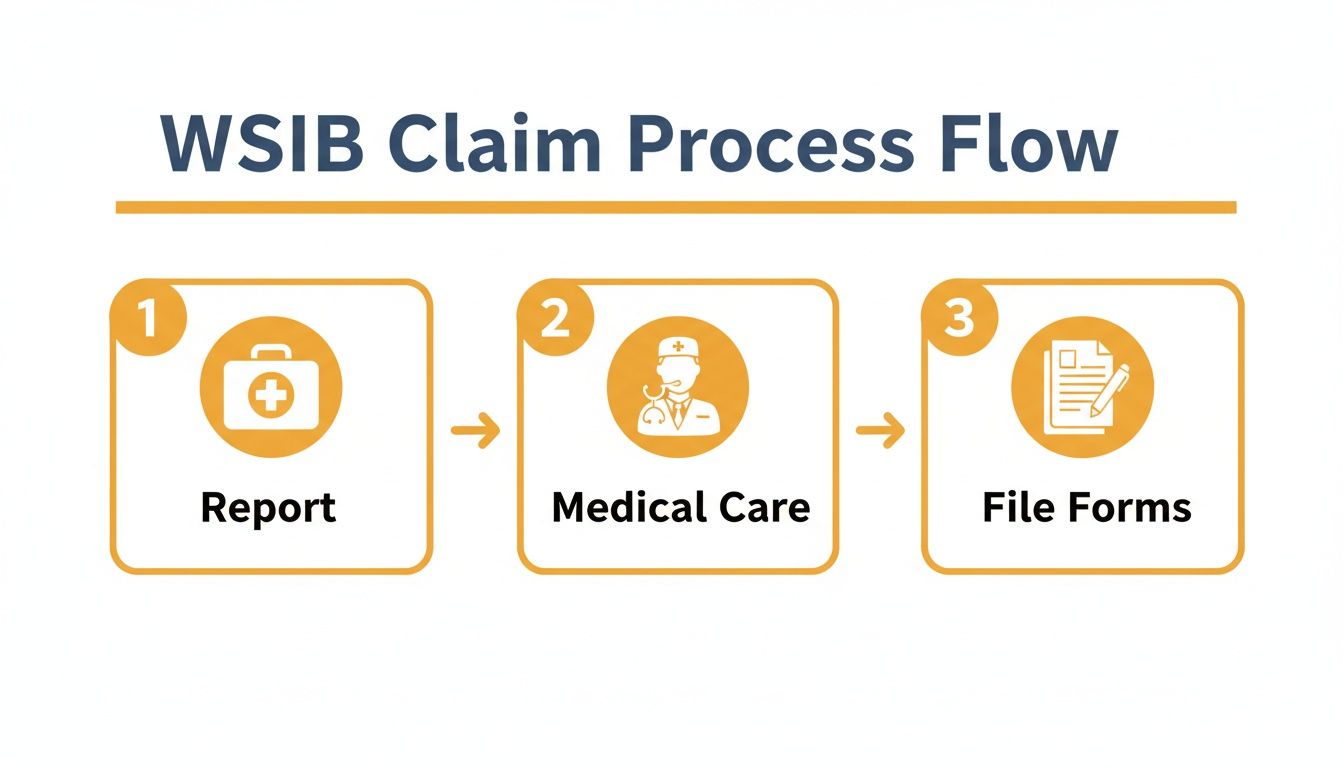
As you can see, solid claims are built on three pillars: quick reporting, immediate medical attention, and accurate forms. These are usually the first things a claims adjudicator will scrutinize.
Common Reasons for WSIB Claim Denials
While every situation has its own unique details, most WSIB denials boil down to a few common themes. They usually revolve around timelines, the quality of your evidence, or whether your injury is truly work-related.
Here are some of the most frequent reasons claims get turned down:
- Missed Deadlines: This is the most clear-cut reason. You either didn’t report the injury to your boss right away or, more critically, you missed the six-month deadline to file your claim with the WSIB.
- Insufficient Medical Evidence: The WSIB needs more than just a doctor’s note. If your medical file is vague or fails to draw a clear line between your work incident and your diagnosis, they’ll likely deny the claim.
- Disputes Over the “Course of Employment”: Sometimes, a decision-maker will argue that you weren’t technically “on the clock” when the injury happened. This gets particularly tricky for people working from home or those who have injuries that developed over time.
- Pre-existing Conditions: This is a classic. The WSIB or your employer might suggest that an old injury or an existing medical condition is the real culprit, not your job duties.
A denial isn’t an accusation; it’s a request for better information. The WSIB is essentially saying, “Based on what we have, we can’t approve this.” Your job now is to provide them with a clearer, more compelling picture supported by solid evidence.
Your Action Plan After a Denial
A denial letter is a call to action, not a reason to give up. The system in Ontario is built with an appeals process specifically to give you another shot at making your case. The trick is to be quick and strategic.
Your first move is to file an “Intent to Object” form within 30 days of the date on your decision letter. This deadline is non-negotiable, so don’t delay. This step asks the WSIB to reconsider the decision, giving you a chance to add new evidence—like a more detailed report from a specialist or witness statements from coworkers.
If the reconsideration doesn’t change the outcome, you can appeal to an Appeals Resolution Officer (ARO). The ARO is a neutral third party who takes a fresh look at your entire claim. They might try to work out a solution through discussion, or they may hold a more formal hearing.
The final stop within the WSIB system is the Workplace Safety and Insurance Appeals Tribunal (WSIAT). This is an independent body that functions a lot like a court. By this point, the process is complex, and having experienced legal representation on your side can make all the difference.
Facing a denial can also be a good time to review other potential safety nets. The challenges of proving a disability, especially with detailed medical evidence, are similar across different systems. For more context, you can learn about the differences in our guide on long-term disability insurance.
Knowing When to Get Legal Help for Your WSIB Claim
While many WSIB claims go through without a hitch, some situations should immediately raise a red flag. It might seem manageable to navigate the system on your own at first, but when things get complicated, a legal expert can become your most important ally in protecting your right to benefits.
Recognizing these moments early can stop small issues from spiraling into major roadblocks that get in the way of your recovery. You don’t have to wait until you’re completely overwhelmed to ask for help.
Key Signs You Need a Lawyer
Some scenarios are just notoriously difficult for an injured worker to handle alone. If any of the following situations sound familiar, it’s a strong signal that you need professional legal advice to make sure your rights are protected and your side of the story is heard.
These aren’t battles you should have to fight while also trying to heal.
Think of a lawyer not as a last resort, but as a specialized navigator. When the WSIB process turns from a straight road into a confusing maze, they provide the map and compass to guide you through, ensuring you don’t get lost in the bureaucracy.
Common red flags include:
- Your benefits are suddenly reduced or stopped: If your payments are cut off without a clear and reasonable explanation, a lawyer can step in, challenge the decision, and fight to get them reinstated.
- Your employer is pressuring you to return to work: An employer can’t force you back on the job before you’re medically ready. A legal professional can intervene to protect both your health and your job security.
- The WSIB is questioning your injury: If the Board disputes how severe your injury is or argues it isn’t work-related, you’ll need to build a rock-solid case with compelling medical evidence—something a lawyer specializes in.
- Your claim has been denied: A denial kicks off a complex appeals process. A lawyer can take over, managing all WSIB communications, gathering the necessary evidence for a strong appeal, and representing you at hearings.
Ultimately, a dedicated legal expert can take the immense weight of the claims process off your shoulders. They handle the paperwork, the deadlines, and the back-and-forth negotiations, freeing you up to focus on what truly matters: your health and recovery. For more on this, you might be interested in our guide on what to expect when hiring a lawyer for an insurance claim.
Common Questions About Ontario Workers’ Compensation Benefits
When you’re trying to navigate a WSIB claim, a lot of practical questions are bound to pop up. Getting clear, straightforward answers is the first step to feeling like you’re back in control. Let’s tackle some of the most common concerns we hear from injured workers across Ontario, from our home base in Burlington to all of the GTA.
How Long Do WSIB Benefits Last?
Loss of Earnings (LOE) benefits are there to provide a financial safety net while you’re recovering. These payments will typically continue until one of three things happens: you’re no longer impaired by your injury, you no longer have a wage loss because of it, or you turn 65.
If your injury leaves you with a permanent impairment, you might also be eligible for a Non-Economic Loss (NEL) award. Think of this as a one-time, lump-sum payment that recognizes the lasting physical impact the injury has had on your day-to-day life.
Can I See My Own Doctor for a WSIB Injury?
Yes, absolutely. You have every right to choose your own healthcare team—whether that’s your trusted family doctor, a specialist they refer you to, or your preferred physiotherapist. These professionals are vital, as they’ll be documenting your injury and recovery progress for the WSIB.
That said, the WSIB does have the right to request an independent medical examination (IME). This is simply an appointment with a different doctor, selected by the WSIB, to get a second opinion on your condition. It’s important to know that attending this assessment is mandatory if you want your claim to move forward.
It is illegal for an employer in Ontario to fire you or penalize you in any way simply for filing a WSIB claim. This action is known as a ‘reprisal’ and is strictly prohibited under the Workplace Safety and Insurance Act (WSIA).
If you suspect you’ve been fired because you filed a claim, you need to act fast. These situations get legally complicated, quickly, often involving both the WSIA and Ontario’s broader employment laws. It’s wise to understand your rights regarding a potential workplace injury lawsuit.
If your WSIB claim has been denied, your benefits have been cut off, or you’re feeling pressured by your employer, you don’t have to go through it alone. The team at UL Lawyers, based in Burlington and serving all of the GTA and Ontario, is here to protect your rights and fight for the compensation you deserve. Contact us for a free consultation at https://ullaw.ca.
Related Resources
What Is Wrongful Dismissal in Ontario: A Guide to Your Termination Rights
Continue reading What Is Wrongful Dismissal in Ontario: A Guide to Your Termination Rights7 Best Employment Lawyers in Ontario: A Complete 2026 Guide
Continue reading 7 Best Employment Lawyers in Ontario: A Complete 2026 GuideNEED A LAWYER?
We are here 24/7 to address your case. You can speak with a lawyer to request a consultation.
905-744-8888GET STARTED WITH A FREE CONSULTATION
Why Choose UL Lawyers
- Decades of combined experience
- Millions recovered for our clients
- No fee unless we win your case
- 24/7 client support
- Personalized legal strategies