Living Wills in Ontario: A Practical Guide for Modern Planning
If you’ve started looking into a “living will” in Ontario, you’re in the right place, but you might be surprised by what you find. The term itself isn’t legally recognized in our province. What you’re actually looking for is a powerful legal document called a Power of Attorney for Personal Care (POAPC).
Let’s clear up the confusion right away.
Understanding Ontario’s Approach to Healthcare Directives

Many people in Burlington, Toronto, and across the GTA use the phrase “living will” to mean a document that spells out their healthcare wishes if they can no longer speak for themselves. The intention is spot on, but Ontario’s legal system handles it differently. Instead of having a separate “living will,” your instructions are actually built right into a Power of Attorney for Personal Care.
Think of it this way: the POAPC is the official, legally binding vehicle, and your “living will” wishes are the passengers. This one document does two critical jobs:
- It names your decision-maker: You appoint a trusted person, called an “Attorney,” to make healthcare and personal care decisions for you when you can’t.
- It contains your instructions: You provide clear directions—what we often call advance directives—about medical treatments you do or don’t want, your wishes for end-of-life care, and your personal values.
This structure is brilliant because it puts someone you trust in the driver’s seat, with your own words as their map.
Comparing a Living Will and Power of Attorney for Personal Care
To make this crystal clear, here’s a quick comparison of the common term versus the legally recognized document here in Ontario.
| Feature | Living Will (Common Term) | Power of Attorney for Personal Care (Ontario Law) |
|---|---|---|
| Legal Status | Not a formal legal document in Ontario. | Legally recognized and binding under the Substitute Decisions Act, 1992. |
| Primary Function | Expresses your wishes for future medical care (e.g., end-of-life). | Appoints a person (Attorney) and expresses your wishes and instructions. |
| Decision-Maker | Implied; relies on healthcare providers to follow the written wishes. | Explicitly names a person to interpret your wishes and make decisions. |
| Scope | Typically focused on end-of-life treatment. | Can cover all personal care decisions: health, housing, nutrition, safety. |
| Enforceability | May be treated as an expression of wishes but isn’t legally binding on its own. | Legally enforceable; your Attorney has the legal authority to act. |
This table shows why focusing on a Power of Attorney for Personal Care is so important—it’s the only way to make your wishes legally stick.
The Critical Need for Proactive Planning
Unfortunately, there’s a huge gap between people knowing they need these documents and actually creating them. Survey data reveals that less than half of all Canadians—only 48%—have a will, and even fewer have appointed a Power of Attorney. This is a real problem in Ontario, where the absence of a legally recognized “living will” makes a formal POAPC absolutely essential for planning ahead.
Without a valid Power of Attorney for Personal Care, crucial decisions about your health could fall to a court-appointed stranger or a default decision-maker who doesn’t know you or what you value. This can easily lead to family conflicts and outcomes you would never have wanted.
Why the Distinction Matters
Getting the terminology right isn’t just about semantics; it’s about making sure your plan works when you need it most. By focusing on creating a valid POAPC, you ensure your wishes are protected and enforceable under Ontario law. While it’s helpful to read about general concepts like Healthcare Directives and Living Wills, you must apply them within Ontario’s specific legal framework.
This guide will walk you through exactly that.
How a Power of Attorney for Personal Care Works
Think of a Power of Attorney for Personal Care (POAPC) as your personal healthcare rulebook. But it’s more than just a list of instructions. It also appoints a trusted ‘team captain’—your Attorney—to make sure your wishes are followed if you ever can’t speak for yourself. This legal document is a powerful combination of two parts working together to protect you.
At its core, this document is your voice in a medical crisis. It makes sure the care you get is in line with your own values and beliefs, taking the guesswork and potential conflict out of an already difficult time for your family.
Your Trusted Decision-Maker: The Attorney
The first, and most critical, piece of your POAPC is naming your Attorney for Personal Care. This is the person you give legal authority to step into your shoes and make crucial decisions about your well-being. It’s a huge responsibility, as their power covers just about every aspect of your personal life.
Your Attorney’s duties might include:
- Medical Treatments: Agreeing to or refusing medical procedures, tests, or treatments—including life support.
- Housing and Shelter: Choosing where you live, whether it’s your own home with assistance, a long-term care facility, or another arrangement that meets your needs.
- Nutrition and Diet: Making decisions about your food and drink, which is vital if you need a special diet or help with feeding.
- Hygiene and Safety: Making sure you’re getting proper daily care, are dressed appropriately, and are living in a safe place.
This person is your champion. They communicate with your doctors and caregivers to ensure your best interests are always front and centre, using the instructions you’ve already laid out.
Your Personal Instructions: The Advance Directives
While your Attorney is the one making the call, your specific wishes are their map. This is the second key part of the POAPC—the section that acts as an “advance directive” or what many people think of as a “living will” in Ontario. This is where you lay out your values, beliefs, and direct instructions for your future care.
Here’s where you make your voice heard loud and clear on deeply personal matters.
By writing down your wishes, you lift a massive weight off your family’s shoulders. You spare them from having to make agonizing choices in a crisis. Your POAPC turns a confusing, emotional situation into a straightforward process of following your lead.
These instructions remove any doubt for both your Attorney and your healthcare providers.
For example, you can give clear directions on things like:
- Life-Sustaining Treatments: You can state whether you’d want CPR, breathing machines, or feeding tubes if you had a terminal illness with no chance of getting better.
- Pain Management: You might want to make it clear that your top priority is to be comfortable and pain-free, even if that means using medication that could shorten your life.
- End-of-Life Care: You can express a preference to pass away at home instead of a hospital, or share your wishes about receiving palliative care.
Ultimately, a Power of Attorney for Personal Care is a complete plan. It pairs the human touch of a trusted advocate with the clarity of your own written instructions. It’s the best way to ensure that even when you can’t speak, your voice is still the one guiding your care.
Meeting Ontario’s Legal Requirements for Your POAPC
For your Power of Attorney for Personal Care (POAPC) to be a legally effective playbook for your healthcare, it has to follow Ontario’s rules to the letter. A simple mistake could unfortunately render the entire document invalid right when it’s needed most. Think of these requirements as the foundation—if one piece is missing, the whole structure can crumble.
The guiding legislation here is Ontario’s Substitute Decisions Act, 1992. This law sets out a few non-negotiable conditions you absolutely must meet for your POAPC to be valid.
Your Capacity and Age
First things first: you must be mentally capable at the moment you sign the document. In simple terms, this means you understand what a POAPC is and what it means to give someone the authority to make decisions on your behalf. You don’t need to be a legal scholar, but you do need to grasp the document’s purpose and power.
On top of that, there’s a specific age requirement in Ontario.
- You must be at least 16 years old to create a valid Power of Attorney for Personal care.
This rule ensures that the person making these crucial future plans is mature enough to understand the gravity of their decisions. If you don’t meet both the capacity and age requirements, the document simply won’t hold up in the eyes of the law.
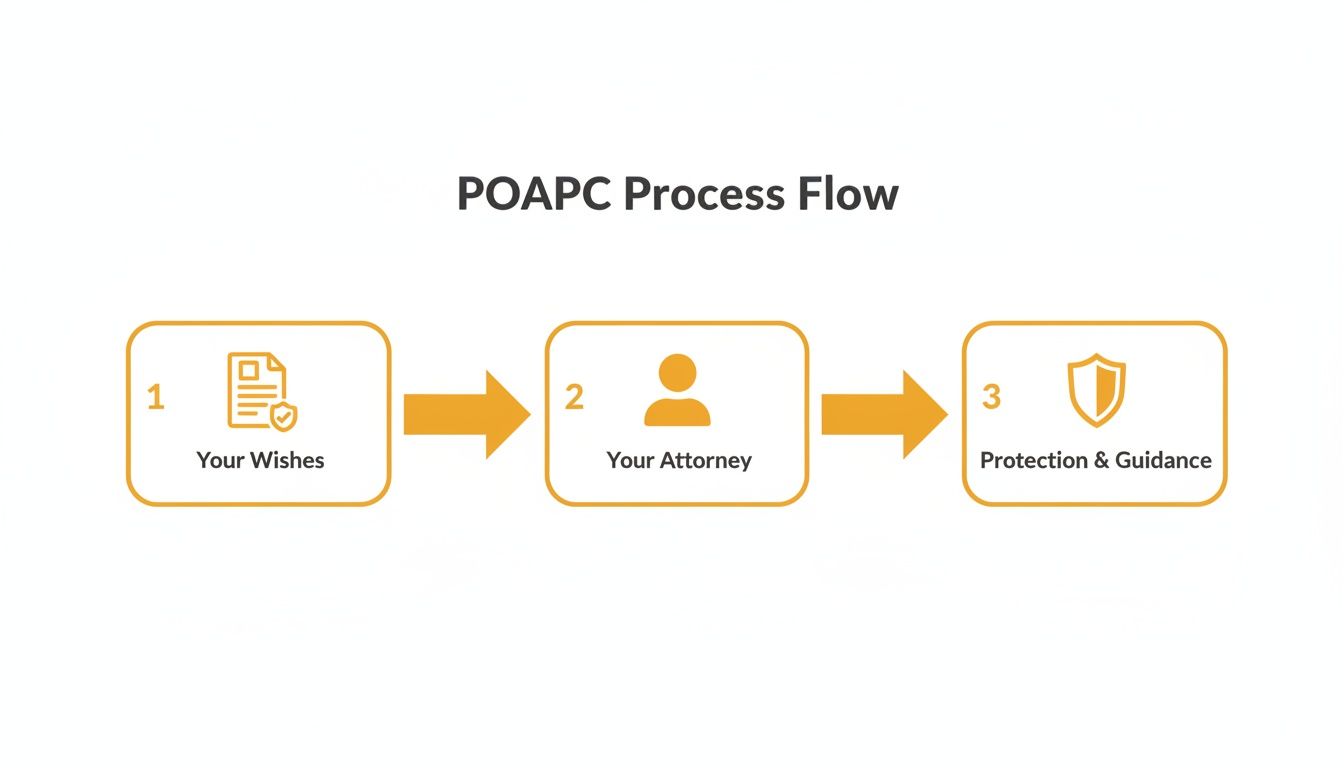
As you can see, a solid plan rests on two pillars: clearly defined wishes and a trusted Attorney to carry them out.
The Crucial Role of Witnesses
The signing process is a common stumbling block where many do-it-yourself documents fail. In Ontario, your POAPC must be signed in the presence of two witnesses. They also have to sign the document in your presence. The rules about who can be a witness are strict for a good reason—they’re designed to prevent conflicts of interest or any hint of undue influence.
A witness’s signature isn’t just a formality; it’s a legal testament that they personally saw you sign the document willingly and with a sound mind. Picking the wrong witnesses can void your entire POAPC.
Understanding who is disqualified from being a witness is just as important as knowing who can be one. The law automatically excludes certain people to protect you and uphold the document’s integrity. These rules exist because those individuals might have a personal stake in your decisions, which could cloud their judgment.
Choosing the right witnesses is vital for the legal validity of your POAPC. The table below breaks down who is eligible and who is not, helping you avoid common pitfalls.
Who Can and Cannot Witness Your POAPC in Ontario
| Eligible to Witness | Ineligible to Witness |
|---|---|
| Most adults who are mentally capable. | Your spouse, partner, or child. |
| A friend or neighbour (as long as they don’t fit into the ineligible categories). | The person you are appointing as your Attorney for Personal Care. |
| A professional colleague. | The spouse, partner, or child of the person you are appointing. |
| Anyone under the age of 18. | |
| A person whose property is under guardianship or who has a guardian of the person. |
This clear distinction helps ensure that the people validating your document are impartial and that your POAPC truly reflects your own wishes, free from any external pressure.
For a more detailed look at these documents, you might find our guide on Power of Attorney documents in Ontario helpful. It provides more context on how different types of POAs work.
Following these regulations precisely is the only way to guarantee your plan is legally sound and ready to protect you when you need it most.
Crafting Clear and Effective Healthcare Wishes
Once you’ve sorted out the legal nuts and bolts of your Power of Attorney for Personal Care (POAPC), you get to the heart of the matter: spelling out your specific healthcare wishes. This is where the document transforms from a legal formality into a deeply personal roadmap for your Attorney. It’s your chance to make sure your values, beliefs, and what matters most to you are crystal clear to everyone involved in your care.
Think of this part of your document as a detailed letter to your future self, your family, and your medical team. Vague instructions like “no heroic measures” can cause a world of confusion and stress because what’s “heroic” to one person might be standard care to another. The real goal here is to be as specific as you possibly can to leave no room for guesswork.
Articulating Your End-of-Life Preferences
One of the most profound aspects of preparing a POAPC is thinking through your wishes for end-of-life care. This means considering difficult scenarios where your quality of life is severely diminished with no reasonable hope of getting better. To give your Attorney clear direction, it helps to tackle specific medical treatments head-on.
Start by asking yourself some foundational questions:
- What does a good quality of life truly mean to me?
- Are there situations where I would not want my life prolonged? (For example, if I were in a permanent coma or had advanced dementia.)
- Is my main goal to live as long as possible, no matter what? Or is prioritizing comfort and peace more important to me?
Answering these questions for yourself builds the “why” behind your decisions, giving your instructions context and personal weight.
Guidance on Life-Sustaining Treatments
Getting specific about life-sustaining treatments is one of the most powerful things you can do in your POAPC. These are the medical interventions that can keep you alive, but they can’t always restore your quality of life. Your document should state your preferences clearly.
Here are a few critical areas to think about:
- Cardiopulmonary Resuscitation (CPR): This is used to restart your heart if it stops. If you have a terminal illness, is this something you would want? You can set out the specific conditions under which you would accept or refuse it.
- Mechanical Ventilation: A ventilator takes over your breathing when you can’t breathe on your own. You can state whether you’d want to be put on a machine, and for how long, especially if there’s little to no chance of recovery.
- Artificial Nutrition and Hydration: This means using feeding tubes when you can’t eat or drink. If you were in a persistent vegetative state, is this a measure you would want? Clear instructions here can guide an incredibly tough decision.
Example Wording: “If I have been diagnosed with a terminal illness with no reasonable hope of recovery, and I cannot communicate my wishes, I direct that I not be placed on a mechanical ventilator. My primary wish is for comfort and dignity.”
Language this clear leaves nothing to chance. It empowers your Attorney to advocate for you with confidence, knowing they are carrying out your explicit instructions.
The Importance of Pain Management and Comfort Care
Beyond just refusing certain treatments, your POAPC should also outline what you do want when it comes to comfort. This is about prioritizing your quality of life—however long that may be—according to your own values.
You can include your thoughts on:
- Pain Relief: You might want to state that you wish to receive enough medication to be free from pain, even if a side effect could shorten your life.
- Location of Care: Do you have a preference for being at home, in a hospice, or in a hospital? Say so.
- Spiritual or Personal Wishes: If certain spiritual, religious, or personal rituals are important to you, include them so your loved ones know.
When thinking through these wishes, it’s a good idea to understand all the options available. Knowing how palliative care services can support you with comfort and dignity can help you write more informed and detailed instructions for your Attorney.
Ultimately, taking the time to craft clear wishes turns your POAPC from a simple legal form into a personal testament. It is a final, incredible gift to your loved ones—sparing them from making impossible decisions in a crisis and ensuring that your voice guides your care, right to the very end.
Choosing the Right Person to Be Your Attorney

Picking your Attorney for Personal Care is probably the most important decision you’ll make in this entire process. This person becomes your voice when you don’t have one. They’re your advocate and your protector when you are at your most vulnerable.
It’s a huge responsibility that goes far beyond simple trust. The person you choose needs a unique mix of emotional strength, clear-headedness, and a rock-solid commitment to honouring your wishes, no matter what.
Think of your Attorney as the guardian of your values. They need to be capable of handling pressure—sometimes from well-meaning family, other times from medical staff—and sticking to the plan you laid out. That means they have to truly get you and what you believe in.
Key Qualities of an Ideal Attorney
When you’re thinking about who to choose, look past who you’re closest to and focus on who is most capable. While a deep bond is important, it’s not the only thing that matters. Your Attorney has to navigate a very complex and emotionally draining situation.
Here’s what to look for:
- Emotional Resilience: Can they keep a level head in a crisis? Making life-or-death decisions is incredibly stressful, and you need someone who won’t crumble.
- Assertiveness: Are they comfortable speaking up? They might need to question a doctor’s recommendation or advocate for a specific course of action. A person who avoids conflict might not be able to enforce your wishes effectively.
- Shared Values: Does this person genuinely understand and respect your views on life, medical treatments, and what “quality of life” means to you? Their job is to channel your beliefs, not their own.
- Availability and Location: This is more practical than legal, but having someone who lives nearby can make a world of difference when decisions need to be made quickly.
The best Attorney is someone who will fight for your wishes, not what they think is best for you. Their personal feelings must take a backseat to the instructions you have laid out in your Power of Attorney for Personal Care.
Having the Conversation and Naming an Alternate
Once you’ve settled on someone, the next step is to have a frank, open conversation. Don’t just spring it on them. Explain exactly what the role involves—the good, the bad, and the emotionally gut-wrenching parts. They need to willingly and consciously accept this responsibility.
Give them a copy of your advance directives and wishes. Let them ask questions. The more they understand your thinking now, the more confident they’ll be in acting on your behalf later.
Finally, and this is crucial: always name a backup. Life is unpredictable. Your first choice could become ill, move away, or simply be unable to handle the role when the time comes. Naming an alternate Attorney ensures your plan doesn’t fall apart, providing a vital safety net for your future care.
While these roles are very different, thinking about who to trust as your Attorney might bring up questions about other key roles, like an Executor. You can learn more by exploring the key distinctions between a Power of Attorney vs an Executor on our blog.
How Proactive Planning Protects You and Your Family
Think of creating a Power of Attorney for Personal Care (POAPC) not as planning for the worst, but as taking the wheel of your own future. It’s a practical step that bridges the gap between your personal values and the realities of Ontario’s healthcare system, acting as a powerful safeguard for you and the people you love.
When a sudden illness strikes, emotions are understandably frayed. Without a clear plan from you, your family is left to guess at what you would have wanted. This uncertainty can easily spark painful disagreements and feelings of guilt. A thoughtfully prepared POAPC cuts through that confusion, providing a single, clear voice—yours—and lifting an immense weight off your family’s shoulders during a crisis.
Your Voice in a Complex System
In today’s medical system, you might not have a lifelong family doctor who knows your values inside and out. In that environment, your POAPC becomes your staunchest advocate. It’s more than just a legal form; it’s a powerful tool ensuring your voice is heard and your instructions are followed, no matter what. This document speaks for you when you can’t.
This kind of planning is more important than ever as Ontario’s population gets older. In 2023, seniors accounted for about 18% of the province, and that number is expected to climb past 25% by 2046. With a potential shortage of family doctors looming, the chances of miscommunication in a medical emergency are very real. A clear POAPC makes sure your wishes are known, even in a system under strain.
Your POAPC is more than just a document; it’s a declaration of your autonomy. It guarantees that the care you receive is aligned with your values, not the assumptions of others or the defaults of the system.
The Ultimate Gift to Your Loved Ones
At the end of the day, the clarity a Power of Attorney for Personal Care provides is a profound act of love. It protects your family from the stress of making agonizing decisions and gives them the peace of mind that comes from knowing they are honouring your exact wishes.
By taking this step, you ensure your personal care decisions remain firmly in your hands. A POAPC is a cornerstone of any solid estate plan, but it’s just one piece of the puzzle. To see how it fits together with other vital documents, our guide on how to make a will in Ontario can help you build a complete strategy to protect yourself and your family.
Common Questions About Ontario Powers of Attorney
When you start digging into estate planning, a lot of practical questions pop up. It’s completely normal. This section is designed to give you clear, straightforward answers to the most common queries we hear about Powers of Attorney for Personal Care in Ontario. Think of it as a quick reference to clear up any confusion.
What Happens If I Don’t Have a POAPC?
This is a big one. If you become unable to make your own healthcare decisions and you don’t have a Power of Attorney for Personal Care (POAPC), you lose the chance to choose who speaks for you. It’s not left to chance; instead, a default system outlined in Ontario’s Health Care Consent Act, 1996 takes over.
This law sets up an automatic hierarchy of decision-makers. The list starts with your spouse or partner, then moves to your children or parents, and then on to other relatives. If no family member is available, willing, or suitable to take on the role, the Office of the Public Guardian and Trustee might need to be appointed by a court. The bottom line? Without a POAPC, someone you might never have chosen could end up making critical decisions about your health, often without any real insight into what you would have wanted.
Can I Prepare My Own POAPC Without a Lawyer?
Legally, yes, you can. There are government forms and do-it-yourself kits available that allow you to create your own Power of Attorney for Personal Care in Ontario. But—and this is a big but—the risks involved are substantial. The rules for signing and witnessing are incredibly strict, and even a seemingly minor mistake can render the entire document invalid.
A homemade POAPC that fails to meet legal requirements is useless when your family needs it most. Professional guidance is a small investment to ensure your wishes are legally protected and unambiguously clear.
Getting an experienced lawyer to draft or review your POAPC is a wise move. It’s the best way to ensure the document is legally solid, your instructions are crystal clear, and you truly understand the power you’re granting. For a deeper dive into why this formal appointment is so crucial, our article explains the differences between a Power of Attorney and guardianship in more detail.
When Does My Power of Attorney Take Effect?
Your POAPC doesn’t kick in the moment you sign it. It only becomes active if and when a healthcare provider determines that you are mentally incapable of understanding treatment information and making your own healthcare decisions.
Until that specific finding of incapacity is made, you always hold the reins. You retain the full right to make your own choices, no matter who you’ve named as your Attorney. The document is essentially a safety net, designed to activate only when you can no longer speak for yourself, ensuring the wishes you laid out beforehand are respected.
Can I Change or Cancel My POAPC Later On?
Absolutely. You can change or completely revoke your Power of Attorney for Personal Care at any time, with one crucial condition: you must be mentally capable when you do so. These documents are designed to be flexible and adapt as your life and relationships change.
You have a couple of ways to do this:
- Create a new POAPC: Making a new, valid POAPC automatically cancels any older versions.
- Sign a formal revocation: You can also draft and sign a written statement (with two eligible witnesses) that explicitly states the old document is cancelled.
If you do make a change, it’s critical to destroy all copies of the old document. You also need to promptly inform your former Attorney, your new Attorney, your family, and your healthcare providers about the update to avoid any potential confusion down the road.
Planning for your future is one of the most important steps you can take. If you have more questions about creating a Power of Attorney for Personal Care or need help drafting a legally sound document, the compassionate team at UL Lawyers is here to help. Contact us for a consultation to ensure your wishes are protected. https://ullaw.ca
Related Resources
Prenuptial Agreement Canada: Essential Guide to Asset Protection
Continue reading Prenuptial Agreement Canada: Essential Guide to Asset ProtectionHow to Incorporate a Business in Ontario: A Founder's Guide
Continue reading How to Incorporate a Business in Ontario: A Founder's GuideNEED A LAWYER?
We are here 24/7 to address your case. You can speak with a lawyer to request a consultation.
905-744-8888GET STARTED WITH A FREE CONSULTATION
Why Choose UL Lawyers
- Decades of combined experience
- Millions recovered for our clients
- No fee unless we win your case
- 24/7 client support
- Personalized legal strategies