When planning for the future, many people ask about creating a “living will.” It’s a term we hear all the time, but here’s the straightforward truth: a living will is not a legally binding document in Ontario. Instead, the law gives us a more powerful framework for making our healthcare wishes known, primarily through a Power of Attorney for Personal Care and advance care directives.
Let’s break down what this actually means for you.
Demystifying the Living Will in Ontario
Have you ever wondered who would speak for you if an accident or illness left you unable to communicate your own medical decisions? It’s a serious question, and for many people in Burlington, Toronto, and across the GTA, the term “living will” is the first thing that comes to mind. We’ve all seen it in movies—a single, dramatic document where someone outlines all their end-of-life wishes.
In the real world of Ontario law, however, that concept is a bit of a phantom. The idea behind a living will—writing down your preferences for healthcare—is absolutely crucial. But the document itself has no formal legal teeth on its own. It can’t legally compel a doctor or hospital to follow your instructions.
The True Legal Tools for Healthcare Planning
So, if a “living will” isn’t the official answer, what is? Ontario law provides a much more robust, two-part solution to ensure your wishes are respected. Think of it like planning a road trip: one part is the map showing your destination and the route you want to take, and the other is choosing a trusted driver to follow that map if you can’t navigate yourself.
- Your Advance Care Directives: This is your map. It’s where you spell out your specific wishes, values, and instructions about medical treatments, pain management, and end-of-life care. These are your detailed notes on what you would, or would not, want.
- Your Power of Attorney for Personal Care (POAPC): This is your chosen driver. This legally binding document appoints a specific person—known as your attorney or substitute decision-maker—to make choices for you if you become mentally incapable. This person is legally obligated to act on the wishes you’ve laid out.
This is how these pieces all fit together, with your personal wishes always at the core of your plan.
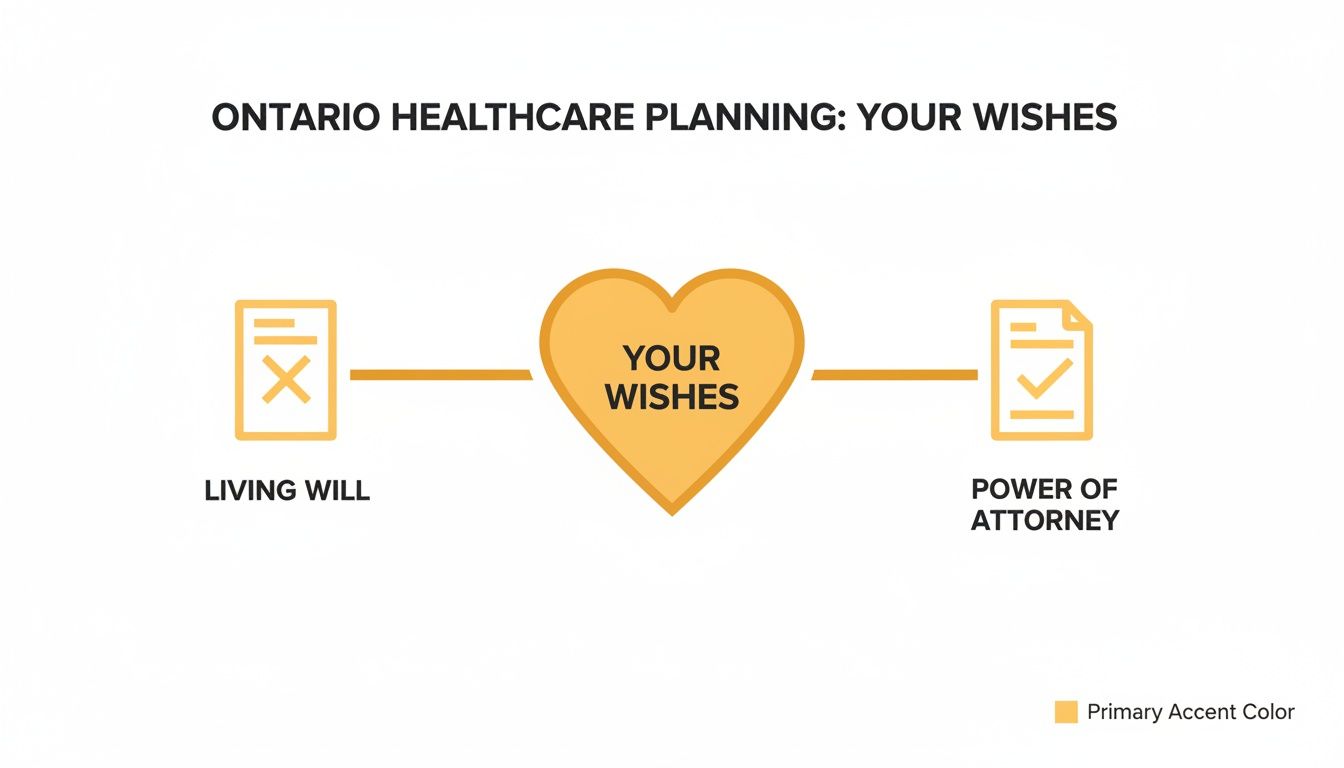
The key takeaway is that while a ‘living will’ captures your intentions, it’s the Power of Attorney for Personal Care that gives those intentions legal force in Ontario.
One boundary is worth stating plainly: a POAPC can record your healthcare wishes, but it cannot be used to pre-authorize Medical Assistance in Dying. Those decisions must still be made at the time and in the manner Canadian law requires.
Why This Distinction Is So Important
Getting this right isn’t just about legal jargon; it has very real consequences. Someone who only writes down their wishes in a simple document, without appointing a Power of Attorney for Personal Care, puts their loved ones and healthcare providers in an incredibly tough spot. Without a legally appointed decision-maker, your family may face confusion, disputes, and delays in trying to honour what you wanted.
In essence, your written wishes inform your appointed decision-maker, but it is the Power of Attorney for Personal Care that gives that person the legal voice to speak for you. One without the other leaves your healthcare plan incomplete and vulnerable.
To help clarify these different but related documents, here is a quick overview of Ontario’s key healthcare planning tools.
Ontario’s Healthcare Planning Documents at a Glance
| Term/Document | Legal Status in Ontario | Primary Purpose |
|---|---|---|
| Living Will | Not legally binding on its own | To express personal wishes and values regarding future medical care. Functions as guidance for your decision-maker. |
| Advance Care Directives | Legally recognized as expressions of wishes | To provide specific instructions about consent or refusal of treatments. Must be followed by your POAPC attorney. |
| Power of Attorney for Personal Care (POAPC) | Legally binding document | To appoint a person (an “attorney”) to make healthcare and personal care decisions on your behalf if you become incapable. |
This table makes it clear that the POAPC is the cornerstone document that gives legal authority to the person you trust to carry out your wishes.
The POAPC is an essential part of any solid estate plan, working hand-in-hand with your Will and Power of Attorney for Property. If you’re trying to understand how the roles of an attorney and an executor differ, our guide on Power of Attorney vs Executor can provide some much-needed clarity.
The Power of Attorney: Your Legal Voice in Healthcare
If a “living will” is your personal script for future healthcare, think of the Power of Attorney for Personal Care (POAPC) as the legally appointed director who makes sure that script is followed. In Ontario, this document isn’t just a good idea—it’s the cornerstone of healthcare planning. It’s the legally recognized tool that gives someone you trust the authority to make critical decisions for you when you can’t.

Here’s the key difference: unlike the informal term “living will,” a POAPC carries real legal weight under Ontario’s Substitute Decisions Act. Your POAPC only comes into play when a healthcare professional determines you’re mentally incapable of understanding your treatment options and making a choice. At that point, your chosen representative literally steps into your shoes, becoming your legal voice.
Who You Can Appoint as Your Attorney
The person you pick is formally called an “attorney,” but they don’t have to be a lawyer. This individual is your substitute decision-maker. You can appoint almost any trusted person who is at least 16 years old—a spouse, an adult child, a sibling, or a close friend.
Honestly, the most important qualifications aren’t legal; they’re deeply personal. You need someone who:
- Understands Your Values: They must be willing to truly listen to your wishes now and have the courage to uphold them later, even if they face pressure from family or medical staff.
- Can Handle Stress: This person might have to make tough calls during an incredibly emotional time. You need someone who is level-headed and can communicate clearly with doctors.
- Is Willing and Available: They have to agree to take on the role. It’s also practical to choose someone who lives nearby or can travel easily to advocate for you when it counts.
Choosing the right person is probably the most significant part of this entire process. Their integrity is what ensures your wishes are actually respected.
The Scope of Their Responsibilities
Your attorney for personal care has significant power over every aspect of your well-being. Their authority is broad and goes well beyond just end-of-life decisions, covering a whole range of choices about your medical treatment and daily life.
This person isn’t just making a single decision; they are managing your quality of life. From consenting to surgery to deciding on your daily diet or where you will live, their role is to ensure every choice aligns with the instructions and values you’ve laid out.
Here are just a few of the specific powers your attorney can exercise for you:
- Medical Consent: They can agree to or refuse any medical treatment, including surgeries, medications, and diagnostic tests.
- Life Support Decisions: They have the final say on life-sustaining treatments like mechanical ventilation or artificial nutrition.
- Living Arrangements: They can decide where you live, whether that’s a long-term care facility, a retirement home, or another supportive setting.
- Daily Care: They can also make decisions about your nutrition, hygiene, clothing, and overall safety.
To get a better handle on the full scope and legal requirements, you can learn more about Power of Attorney documents in Ontario in our detailed guide.
How a POAPC Works in a Real-World Scenario
Let’s look at a practical example. Imagine Sarah, who lives in the GTA, has a severe stroke that leaves her unable to speak or communicate. Her doctors recommend a high-risk surgical procedure with an uncertain outcome. Thankfully, Sarah had already created a POAPC, appointing her brother, David, as her attorney.
In her advance directives, Sarah had clearly stated that she valued quality of life over length of life and wanted to avoid aggressive treatments if the chance of a meaningful recovery was low. David meets with the medical team, shows them the POAPC, and shares Sarah’s written wishes. He asks tough questions about the surgery’s potential benefits versus its burdens.
Based on Sarah’s documented values, David makes the difficult decision to refuse the high-risk surgery. Instead, he consents to a comprehensive palliative care plan focused on her comfort and dignity. The hospital is legally required to follow his decision because he is acting as Sarah’s legal substitute. This story shows the POAPC in action, empowering a trusted person to make sure your voice is heard, loud and clear.
While setting up a Power of Attorney is a crucial step, it’s just as important to understand how to void a Power of Attorney if your circumstances or wishes change. This ensures your legal documents always reflect exactly what you want.
How to Clearly Document Your Healthcare Wishes
When you name someone as your Power of Attorney for Personal Care (POAPC), you’re giving them the legal authority to make decisions for you. But that authority is only half the battle. The real power—and the real gift to your loved one—comes from the clarity of your instructions.
These written instructions, often called advance care directives, are the script your attorney will follow. They ensure the decisions being made are a true reflection of your values, not just their best guess under pressure.

The whole point is to translate your deeply personal beliefs into practical, actionable guidance. Vague phrases like “no heroic measures” can unfortunately cause more confusion than comfort for your family and your medical team. Instead, your goal is to provide specific instructions that leave no doubt about what a good life means to you.
This document is your chance to define your own terms for quality of life. It’s what allows your attorney to confidently navigate the toughest questions, because they’ll be guided by your own words.
From Vague Ideas to Specific Instructions
The most crucial step is turning general feelings into concrete directions. Rather than just listing what you don’t want, it’s far more helpful to describe the specific conditions under which you would or would not want certain treatments.
A great starting point is to ask yourself some foundational questions:
- What makes my life feel meaningful and worth living right now?
- What are my biggest fears or worries about my health and end-of-life care?
- How important is it for me to be conscious and able to communicate with the people I love?
- What does a peaceful and dignified death look like to me?
The answers you come up with form the bedrock of your directives. They provide the “why” behind your instructions, giving your attorney a much deeper understanding of what’s truly driving your decisions.
Crafting Clear Directives for Medical Treatments
Once you’re clear on your core values, you can start applying them to specific medical scenarios. Be direct and try to use simple, everyday language. Think about common life-sustaining treatments and state your wishes as plainly as possible.
Regarding Life Support:
- Vague: “I don’t want to be kept alive by machines.”
- Clear: “If I am in an irreversible coma or a persistent vegetative state, I do not want to be kept on a ventilator (breathing machine). However, I would agree to a temporary trial of a ventilator if my doctors believe there is a reasonable chance I could recover to a state where I can recognize my family and express my needs.”
Regarding Artificial Nutrition and Hydration:
- Vague: “Don’t use feeding tubes.”
- Clear: “If I am unable to eat or drink on my own and my doctors have determined there is no reasonable hope of recovery, I do not want artificial nutrition or hydration (feeding tubes). My wish is to be allowed to die naturally.”
This level of detail is incredibly helpful. It lifts the heavy burden of guesswork off your attorney’s shoulders and empowers them to advocate for you with precision.
Think of your advance care directives as a conversation on paper. They should speak for you with the same clarity and conviction you would if you were able, turning your personal values into a practical roadmap for your care.
To make sure you cover the key areas, it can be useful to organize your thoughts. The table below provides a simple checklist of topics to consider when documenting your wishes.
Key Areas to Address in Your Advance Care Directives
| Healthcare Decision Area | Example Instruction | Why It’s Important |
|---|---|---|
| Life-Sustaining Treatment | ”I do not want CPR if my heart stops and I have a terminal illness.” | Provides clear boundaries on medical interventions at the end of life. |
| Pain and Symptom Management | ”My primary goal is comfort. I consent to any pain medication needed to keep me comfortable, even if it might shorten my life.” | Ensures your quality of life and comfort are prioritized according to your wishes. |
| Hospitalization Preferences | ”I prefer to receive care at home or in a hospice, rather than a hospital, if my condition is terminal.” | Guides decisions about your physical environment and the type of care you receive. |
| Organ and Tissue Donation | ”I wish to donate my organs and tissues for transplantation or research.” | States your intentions clearly so your family can honour them without hesitation. |
| Mental Health Treatment | ”If I become incapable of making decisions due to dementia, I do not consent to electroconvulsive therapy (ECT).” | Addresses specific treatments related to cognitive decline and mental health. |
This isn’t an exhaustive list, but it’s a solid framework to ensure you’re thinking through the most common and critical decisions your attorney might face.
Addressing Pain Management and Comfort
Finally, your directives should always include your wishes for comfort and palliative care. This is a vital part of ensuring your quality of life is front and centre, especially when curative treatments are no longer the goal.
Be explicit about what matters to you.
- Pain Management: You could say something like, “My main priority is to be comfortable and free from pain. I authorize my attorney to approve any dose of pain medication required to ease my suffering, even if a side effect is that it may hasten my death.”
- Palliative Care: Consider including, “If I am diagnosed with a terminal illness, I want to receive palliative care, whether at home or in a hospice. The focus should be on my comfort, dignity, and emotional well-being.”
By clearly documenting these wishes as part of your overall plan for a living will in Ontario, you paint a complete picture of your priorities. This ensures the person you trust is not just legally empowered to act, but is also perfectly clear on what matters most to you, no matter what happens.
Common Mistakes to Avoid in Your Advance Care Plan
Putting a plan in place for your future healthcare is one of the most powerful things you can do for yourself and your family. But even the most well-intentioned plans can fall apart if you make a few common, practical mistakes. These slip-ups can leave your loved ones confused and your wishes ignored when it matters most.
The goal isn’t just to have a legally valid document, but one that actually works in the real world. A solid plan brings clarity and peace of mind during a crisis. A flawed one just adds more stress to an already difficult situation.
Picking the Wrong Person for the Job
One of the biggest—and most damaging—mistakes is choosing the wrong person as your attorney for personal care. It’s easy to feel obligated to pick your spouse or eldest child, but that’s not always the wisest choice. This role demands someone who can stay level-headed, communicate assertively with doctors, and handle the emotional weight of making tough calls under pressure.
Think about this: Mark named his son, who lived in another province and hated confrontation, as his attorney. When Mark’s health declined, his son struggled to travel for meetings and was too intimidated to question the medical team’s recommendations, even when they didn’t seem to line up with Mark’s written instructions.
The right person is someone who truly gets your values, can communicate clearly, and has the backbone to be your fierce advocate when you can’t speak for yourself.
Using Fuzzy or Unclear Language
Another classic blunder is writing down instructions that are too vague. Phrases like “no heroic measures” or “no extraordinary means” sound decisive, but they’re wide open to interpretation. What you consider “heroic” might be what a doctor or your family member considers standard, life-sustaining treatment.
This kind of ambiguity puts your attorney in the awful position of having to guess what you really meant, which can cause arguments and delays in your care.
A living will in Ontario is only as strong as its clarity. Your instructions have to be specific enough to guide your attorney’s hand, leaving no room for doubt about what a meaningful quality of life looks like to you.
Instead of broad statements, get specific. Spell out exactly which treatments you would want or refuse—like CPR, ventilators, or feeding tubes—and under what precise medical conditions.
Forgetting to Have the Tough Conversations
Signing the paperwork is only half the battle. You have to talk about it. A huge oversight is failing to sit down and have candid conversations with your chosen attorney and other key family members. If your wishes come as a shock in the middle of a medical emergency, it can create a lot of emotional turmoil and conflict.
Your attorney needs to hear the ‘why’ behind your decisions, straight from you. That conversation gives them the context and the confidence to follow through. And telling your family ahead of time helps manage everyone’s expectations and makes it less likely that someone will challenge the plan later.
Grabbing a Generic Template Off the Internet
The web is full of “do-it-yourself” legal forms, but using a generic template that isn’t designed for Ontario law is a serious gamble. Here, the Substitute Decisions Act has very specific rules for how a Power of Attorney for Personal Care must be created and witnessed. A form from another province or country probably won’t hold up.
These documents are far too important to leave to a template. A one-size-fits-all form can’t possibly account for your unique family dynamics or use the careful wording needed to head off future disagreements. Getting proper legal advice ensures your plan is airtight, comprehensive, and actually protects you.
This kind of planning is more critical than ever. We’re seeing a major gap between how many Ontarians need an estate plan and how many have actually done it. Current statistics show that only 48% of Canadians have a will, and the numbers are even lower for younger people. This points to a worrying trend: as our population gets older, too few people are taking the steps to legally document their wishes. You can explore the full research on these Canadian estate planning perspectives to see the data for yourself.
How to Properly Sign, Store, and Update Your Documents
You’ve done the hard work of thinking through your future healthcare and creating a plan. That’s a massive step. But a brilliantly drafted document is no good if it can’t be found in an emergency or, even worse, isn’t legally valid.
Getting these final details right—signing, storing, and updating—is what turns your thoughtful wishes into an actionable, legally sound plan that your family and healthcare team can rely on.
Making It Official: The Rules for Signing and Witnessing
In Ontario, a Power of Attorney for Personal Care (POAPC) needs to be signed and witnessed correctly to have any legal weight. This isn’t just red tape; it’s a crucial safeguard that proves the document is genuinely yours.
The process is straightforward, but the rules are strict.
- You must sign it yourself. This is your confirmation that everything in the document reflects your decisions.
- Two witnesses must be present. They need to physically watch you sign and then sign the document themselves, right there with you.
Think of your witnesses as impartial observers whose signatures confirm you were of sound mind and signed the document freely, without any pressure.
Under Ontario’s Substitute Decisions Act, not just anyone can be a witness. Choosing the wrong person can make your entire document invalid, so it’s critical to get this right.
So, who can’t be a witness? The rules are clear. A witness cannot be:
- Your spouse or partner
- Your child or someone you treat as your child
- Your chosen attorney for personal care (or their spouse/partner)
- Anyone under the age of 18
Storing Your Documents for Easy Access
Once everything is signed, where do you put it? Many people instinctively think a bank safety deposit box is the most secure option. This is actually a common and critical mistake. If you have a medical emergency on a holiday weekend, that box is inaccessible, leaving your attorney powerless.
Instead, keep the original document in a safe but accessible spot at home. Then, give copies to the key people in your life.
Who needs a copy?
- Your attorney for personal care (and any backups you named)
- Your family doctor
- Close family members who need to be in the loop
- Your estate lawyer
These documents contain your most sensitive health information, so sharing them securely is vital. For more on protecting this data, you can find helpful guidance on secure document sharing.
Keeping Your Plan Current
Your wishes aren’t set in stone. Think of these documents as living—they should grow and change as you do. The plan that felt right at 50 might not reflect your values at 75. That’s why reviewing your plan regularly is so important.
It’s a good idea to pull out your documents and reread them after any major life event, like:
- A significant new medical diagnosis
- A change in your marital status (getting married or divorced)
- The death of your appointed attorney or a close family member
- A major shift in your personal values or beliefs
By giving your plan a regular check-up, you ensure the guidance you provide for your living will in Ontario is always clear and up-to-date. To stay on top of it, our Estate Planning Checklist for Canada can be a really helpful guide.
Why an Estate Lawyer Is Your Best Ally in Planning
It’s tempting to grab a DIY kit or an online template to sort out your estate. They seem quick and easy, but they rarely get to the heart of what your family actually needs. When it comes to something as personal as a living will in Ontario, a generic form is no substitute for the guidance of an experienced estate lawyer. This process is about so much more than just filling in blanks on a form—it’s about building a legal safety net that truly reflects your values and wishes.

An estate lawyer wears many hats. We don’t just draft documents; we act as your strategic partner, helping you see around corners and head off potential conflicts before they start. Our job is to ask the tough “what if” questions, clear up any grey areas, and make sure the legal wording is crystal clear, leaving no room for doubt or misinterpretation by your family or healthcare providers.
Navigating Modern Family Dynamics
Let’s face it, families today can be complicated. We see everything from blended families with step-children to common-law relationships, and a one-size-fits-all document is almost guaranteed to miss something important. A lawyer who’s seen it all can structure your Power of Attorney and advance directives in a way that navigates these unique dynamics and minimizes friction.
This kind of personalized planning is becoming more crucial every day. Ontario is constantly changing; its aging population is expected to jump from 18% to over 25% by 2046. That means more people are going to need clear, effective plans in place. To get a better sense of these trends, you can learn more about Ontario’s population projections and what they mean for families like yours.
A skilled lawyer ensures your plan isn’t just legally sound—it’s also built to withstand the realities of your specific family situation. That foresight is what you’re really paying for. It turns a simple piece of paper into a powerful protective shield.
Ensuring a Seamless Estate Plan
Your healthcare wishes don’t exist in a bubble. They need to work hand-in-glove with your will and your Power of Attorney for Property. A lawyer makes sure all your estate planning documents are perfectly aligned, preventing any contradictions that could cause confusion or even legal battles later on. This holistic approach ensures your instructions for your health, your finances, and your legacy are all telling the same story.
At UL Lawyers, we pride ourselves on a compassionate, client-first approach. We serve families across Burlington, the GTA, and all of Ontario, giving them the peace of mind that only comes from a professionally prepared plan. We take the time to really listen—to understand you, your values, and your family. For more guidance, our team of estate planning lawyers is ready to help.
Don’t leave something this important to chance. Secure your wishes and protect the people you care about by speaking with our team. We’re here to offer the expert guidance you need to create a plan that gives everyone confidence and clarity for the future.
Your Top Questions About Living Wills in Ontario, Answered
Even with a plan in place, it’s natural to have questions about how these documents work in real life. Let’s tackle some of the most common ones we hear from our clients, so you can feel confident about your decisions.
What Happens If I Don’t Have a Power of Attorney for Personal Care?
This is a critical point that many people miss. If you become unable to make your own healthcare decisions and you haven’t appointed a Power of Attorney for Personal Care (POAPC), the choice of who speaks for you is taken out of your hands.
Instead, Ontario’s Health Care Consent Act steps in and assigns a substitute decision-maker for you. The law follows a strict hierarchy, starting with your spouse or partner, then moving down a list to children, parents, and other relatives. If no family is available or willing, the Office of the Public Guardian and Trustee could be appointed. That means a stranger—or a relative you never would have chosen—could be making your most intimate decisions, often without any written guidance from you.
Can My Attorney for Personal Care Also Handle My Money?
No. In Ontario, these are two completely separate legal jobs. Your Power of Attorney for Personal Care is exclusively for decisions about your health, living arrangements, nutrition, and personal safety. That’s its entire focus.
To give someone the authority to manage your finances—think banking, paying bills, or overseeing investments—you need a Power of Attorney for Property. You can absolutely name the same person for both roles, which is a common choice for simplicity. But they must be created as two distinct legal documents, each spelling out its own specific powers and duties.
A lot of people assume one Power of Attorney document covers all the bases. But Ontario law deliberately separates your personal care from your property to ensure each area gets the focused attention it deserves. Naming the same person can make things easier, but legally, they are wearing two different hats.
Can I Appoint More Than One Person as My Attorney?
Yes, you can, but you have to be crystal clear about how they’ll work together. The law requires you to state whether they must act:
- Jointly: This means every single attorney must agree on every decision. While it offers a check and balance, it can lead to deadlocks and dangerous delays during a medical crisis if they can’t see eye to eye.
- Jointly and Severally: This allows any one of your attorneys to make a decision independently. It’s much more flexible, but it demands an incredible amount of trust that they will all communicate and act in harmony.
A more practical approach is often to appoint one primary attorney and then name one or two alternates. The alternate only steps in if your first choice is unable or unwilling to act, which neatly sidesteps any potential for conflict. For more on how this document fits with your broader estate plan, see our guide on how to make a will in Ontario.
Do Doctors Really Have to Listen to My Attorney?
Yes, they do. It’s the law. The moment you’re determined to be incapable of making your own healthcare decisions, your legally appointed attorney effectively becomes you for medical purposes. Doctors and healthcare providers in Ontario are legally required to get informed consent from your attorney, just as they would have from you.
Those written wishes you laid out—the “living will” part of your plan—serve as the playbook for your attorney. As long as your instructions are clear, specific, and lawful, your attorney and your medical team are bound to follow them. A well-drafted POAPC with detailed advance directives removes all the guesswork and makes sure your voice is the one that matters most.
Figuring out the details of a living will in Ontario can feel overwhelming, but you’re not in this by yourself. The experienced team at UL Lawyers is here to provide the expert guidance you need, ensuring your wishes are legally solid and clearly expressed. Contact us today for a consultation and get the peace of mind that comes from knowing you have a professional plan in place.