Living Will Ontario: A Complete Guide to Advance Directives
If you’ve ever typed “living will Ontario” into a search engine, you’ve probably waded through a lot of confusing, and sometimes conflicting, information. Let’s clear things up right away: in Ontario, there’s technically no legal document called a “living will.” The powerful legal tool we use to accomplish the same goals is called a Power of Attorney for Personal Care (POAPC).
What Happened to the “Living Will”?

While the term “living will” isn’t legally recognized here, the idea behind it is absolutely vital. Think of the concept of a living will as your personal instruction manual for future healthcare. It’s where you’d write down your values, beliefs, and specific wishes about the medical treatments you would or would not want if you couldn’t speak for yourself.
This set of instructions is a cornerstone of advance care planning. In Ontario, the legally binding document that puts these wishes into action is the Power of Attorney for Personal Care.
A POAPC does two crucial things:
- It names your champion. You appoint a trusted person—your “Attorney” for personal care—who has the legal authority to make decisions for you.
- It gives them your playbook. It contains your specific instructions and values, guiding your Attorney to make choices you would have made.
So, while you might think of your wishes as a “living will,” the POAPC is the official document that gives those wishes legal force in Ontario.
To make this crystal clear, let’s break down the differences.
Living Will Concept vs Power of Attorney for Personal Care
| Feature | Living Will (Informal Concept) | Power of Attorney for Personal Care (POAPC) |
|---|---|---|
| Legal Status in Ontario | Not a legally recognized document. | Legally binding under the Substitute Decisions Act, 1992. |
| Primary Function | A statement of your wishes for medical care. | Appoints a person (Attorney) and provides them instructions. |
| Decision-Maker | The document itself tries to speak for you. | Your chosen Attorney speaks for you, guided by the document. |
| Scope | Typically focused only on end-of-life medical care. | Covers a broad range of personal care decisions (health, housing, etc.). |
| Flexibility | Static; cannot adapt to unforeseen circumstances. | Dynamic; your Attorney can interpret your wishes in new situations. |
As you can see, the POAPC is a much more robust and flexible tool for ensuring your future is in the hands of someone you trust.
The Power of Attorney for Personal Care Is Key
Governed by Ontario’s Substitute Decisions Act, 1992, the POAPC is the document that empowers your chosen Attorney to make a whole range of decisions if you become mentally incapable of doing so yourself.
A Power of Attorney for Personal Care is your voice when you can no longer speak for yourself. It’s a profound act of trust, ensuring your deepest beliefs about your health, housing, and well-being are honoured by someone who knows you best.
This isn’t just about end-of-life decisions. The authority of a POAPC extends to everyday, yet critical, aspects of your life, including:
- Medical Treatments: Consenting to or refusing surgeries, medications, and therapies.
- Housing: Deciding if you should remain at home with support or move to a long-term care facility.
- Nutrition and Hygiene: Making choices about what you eat and your daily care routines.
- Safety: Approving measures to keep you safe and secure.
Without a POAPC, these intensely personal decisions could fall to a family member from a legally-defined hierarchy or, in some cases, the Office of the Public Guardian and Trustee. That means a relative you’re not close with—or even a government official—could be making life-altering choices on your behalf.
This document is a critical part of a complete estate plan. It works alongside the document that handles your finances, and you can learn more by reading our detailed guide on what a Power of Attorney for Property is.
Why Advance Care Planning Is a Necessity, Not a “Someday” Task
Let’s be honest: thinking about a time when you can’t speak for yourself is tough. It’s a conversation most of us would rather put off. But pushing it to the back burner can create a world of pain and confusion for the people you love most. In Ontario, many people see this as a problem for the distant future, something to deal with “when they’re older.” This is a dangerous mistake.
The truth is, your ability to make your own decisions can be taken away in an instant. A sudden accident on the QEW, a bad fall, or a surprise diagnosis doesn’t just affect you—it throws your family into a crisis. Suddenly, they’re huddled in a hospital waiting room, grappling with unimaginable stress and forced to make life-or-death decisions without knowing what you would have wanted.
When you haven’t left clear instructions, you’ve left them with a guessing game. And that ambiguity is a breeding ground for conflict. Siblings might clash over treatment options, spouses and parents may disagree, and relationships can be permanently fractured, all while they’re trying to cope with your medical emergency.
The Heavy Price of Unpreparedness
Without a Power of Attorney for Personal Care, the fallout isn’t just emotional. It can become a legal and financial nightmare. If your family can’t agree on your care, they may have to go to court and apply to become your legal guardian. This isn’t a simple process; it’s often slow, expensive, and incredibly stressful.
This means critical decisions about your health—your life—get put on hold while the legal system grinds along.
Imagine your family, already sick with worry, having to hire lawyers and navigate a court battle just to get the authority to honour what they think you would have wanted. This isn’t a rare occurrence. It’s a preventable reality for thousands of families across Ontario.
This lack of planning is alarmingly common. A recent Canadian survey found that only about 48% of Canadians have a will, leaving more than half the population without even the most basic estate planning document. The numbers for advance care directives are just as concerning. This gap is even more stark among younger people, where only 30% of those aged 18-34 have made their wishes official. To see how Ontario’s population trends impact these statistics, you can explore projections on the official government page.
Real-Life Scenarios in Ontario
Let’s move this out of the theoretical and into the real world. These are the kinds of situations that unfold every day, showing exactly why a Power of Attorney for Personal Care is so vital for every adult.
- The Unexpected Accident: A young professional from Mississauga is hit by a car while cycling and ends up on a ventilator, unable to communicate. Her parents and her common-law partner are at odds over continuing life support. With no document to guide them, their grief turns into a painful legal fight.
- The Sudden Illness: A small business owner in Burlington suffers a massive stroke. His adult children are forced to decide whether to approve a high-risk surgery with a low chance of success. The agonizing decision tears the family apart.
- The Gradual Decline: An elderly mother in the GTA is diagnosed with dementia. Her wish was always to stay in her home, but without a Power of Attorney for Personal Care outlining that preference, she’s moved into a long-term care facility. It was simply the easiest path for the healthcare system to take.
In every single one of these cases, a clear, legally sound document would have replaced chaos with clarity. It would have turned conflict into peace of mind. This plan isn’t just about you; it’s one of the most profound gifts you can give your family. Thinking about these documents is a core part of effective estate management, making sure your wishes for both your personal care and your assets are respected.
Ultimately, advance care planning isn’t a morbid task to be dreaded. It’s an act of responsibility and love. It’s about taking control of your own story and protecting your family from having to make impossible choices in their darkest hour. If you’re ready to create a comprehensive plan, you can learn more by exploring our guide on wills and estate law.
How a Power of Attorney for Personal Care Works
Let’s imagine you’re the captain of a ship, navigating through life. You have a clear destination in mind, guided by your personal values and what you hold dear. In Ontario, a Power of Attorney for Personal Care (POAPC) is like your ship’s logbook and emergency plan all in one. It legally appoints a trusted first mate—your “Attorney”—and gives them your detailed voyage plan to follow if you ever become unable to steer the ship yourself.
This document gets its legal teeth from two key pieces of Ontario legislation: the Health Care Consent Act, 1996 and the Substitute Decisions Act, 1992. It serves two powerful, interconnected purposes.
First, you name a specific person to act on your behalf. This is your Attorney for personal care, also known as your substitute decision-maker. They are the person who will literally step into your shoes to make critical decisions when you can’t.
Second, you give them instructions. This is where the idea of a “living will” really takes shape within the POAPC. You can get specific about your wishes for medical treatment, end-of-life care, where you want to live, what you eat, and your general safety. You’re not just naming someone; you’re giving them a roadmap.
The diagram below shows the difficult path families are often forced down when there’s no plan in place.
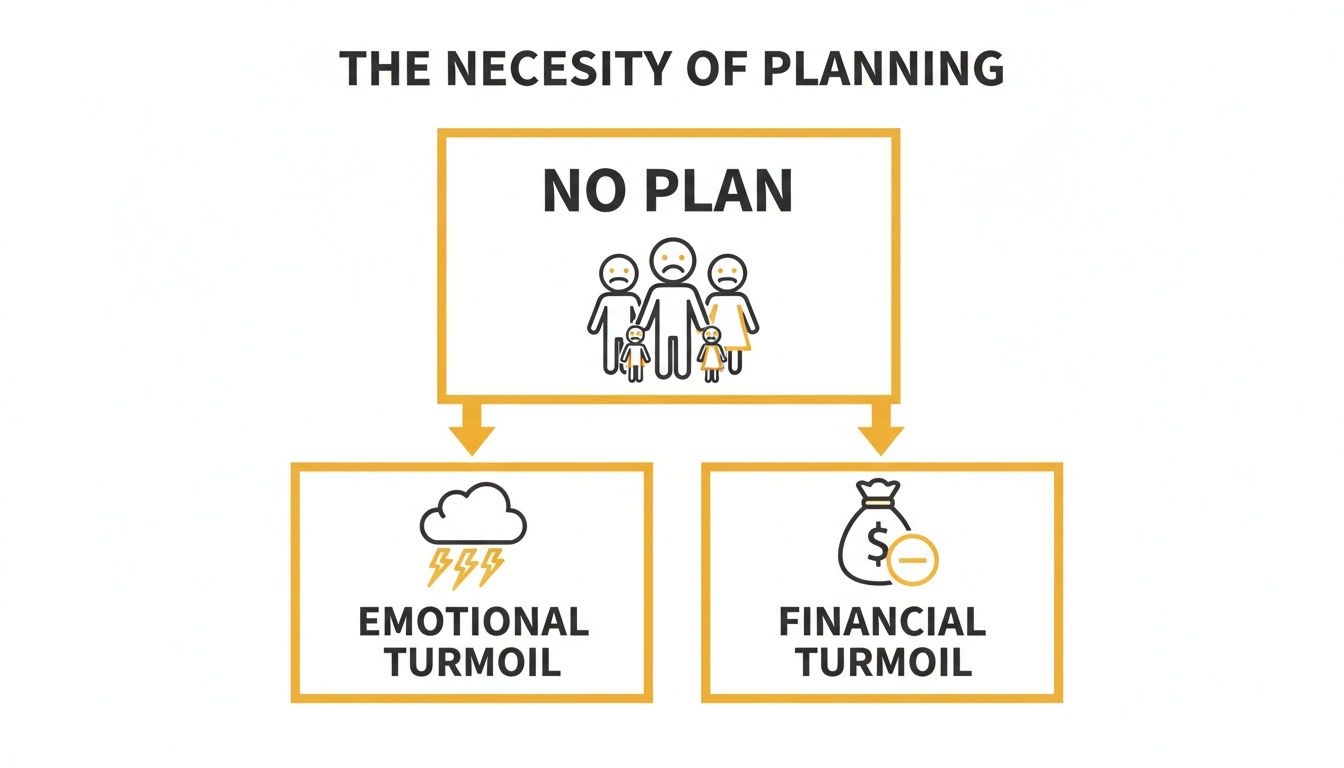
As you can see, a lack of planning doesn’t just create legal problems—it creates real emotional and financial distress for the people you love most.
The Legal Requirements for a Valid POAPC in Ontario
For your Power of Attorney for Personal Care to be legally binding in Ontario, it has to follow some strict rules. Think of them as a pre-flight checklist. Miss just one, and the whole plan could be grounded.
Your document must be:
- Made While You Are Capable: You need to be at least 16 years old and mentally capable of understanding what a POAPC is and what it means to sign one. This is exactly why it’s so important to do this ahead of time; you can’t make one after you’ve already lost capacity.
- In Writing: It has to be a physical document. A verbal agreement or a casual understanding simply won’t hold up legally.
- Signed and Dated by You: Your signature makes it official and confirms the document reflects your true wishes.
- Signed by Two Witnesses: Two other people need to physically watch you sign the document and then sign it themselves, right there in your presence.
These aren’t just bureaucratic hurdles. These legal formalities are safeguards, designed to protect you from fraud or being pressured into a decision, ensuring the document is genuinely yours.
Who Cannot Be a Witness
Picking the right witnesses is just as crucial as any other step. To prevent any conflicts of interest, Ontario law is very clear about who cannot witness you signing your POAPC.
Important Note: A Power of Attorney for Personal Care only kicks in if you are found to be mentally incapable of making your own personal care decisions. Until that moment, you are always the one in charge.
The following people are not allowed to be a witness:
- Your spouse or partner
- Your child (or someone you treat as your child)
- The person you are appointing as your Attorney for personal care
- The spouse or partner of your appointed Attorney
- Anyone under the age of 18
Getting the witnessing rules wrong can make your entire POAPC invalid. That would leave your family in the lurch, without guidance precisely when they need it most. It’s why taking the time to understand the nuances of Power of Attorney documents in Ontario is so critical.
Choosing Your Attorney: A Decision of Ultimate Trust
Selecting your Attorney is, without a doubt, the single most important decision you’ll make in this process. This isn’t just a name on a form. You need a steadfast advocate who can handle immense pressure with grace and clear-headedness.
Legally, your chosen Attorney must be at least 16 years old and mentally capable themselves. But beyond the legalities, ask yourself these tough questions:
- Do they truly get me? Can they make the decision I would make, even if it’s not the one they’d choose for themselves?
- Can they handle a crisis? Making life-or-death decisions is incredibly stressful. Can they cope?
- Are they assertive enough? Will they be able to communicate my wishes to doctors and hospital staff, even if they get pushback?
- Are they close by? While not a legal requirement, having someone local can make a world of difference when they need to be there for important conversations.
Your Attorney holds your well-being in their hands. Choose with care, and then have a frank conversation with them to make sure they’re willing and able to take on this profound responsibility.
Putting Your Wishes into Words: How to Draft Your Directives

Once you’ve chosen the right person to be your Attorney, the next crucial step is to arm them with your voice. This is where you translate your personal values into clear, actionable instructions inside your Power of Attorney for Personal Care. It’s your chance to give them a roadmap that truly reflects who you are.
Don’t think of this as just another legal document. See it as a detailed conversation with your future self and the person you’ve put your trust in. The real art is striking the right balance—being specific enough to provide clear guidance, but also flexible enough to let your Attorney handle the unexpected twists and turns that healthcare can bring.
Generally, your instructions will cover two main territories: critical medical decisions and your broader personal care preferences.
Articulating Your Medical and End-of-Life Wishes
Let’s be honest, this is the tough part. It means thinking through difficult “what if” scenarios. But being crystal clear here is one of the greatest gifts you can give your decision-maker. It lifts the immense burden of guesswork from their shoulders during what will already be a stressful time.
You’ll want to outline your preferences on key medical treatments. You don’t need to be a doctor or use complicated jargon. Simple, direct language is always best.
Sample Phrasing for Common Scenarios:
- On Life-Sustaining Treatment: “If I am diagnosed with an incurable terminal illness or am in a permanent vegetative state with no reasonable chance of recovery, I do not want my life prolonged by artificial means. This includes refusing treatments like CPR, mechanical ventilators, and artificial nutrition or hydration (feeding tubes).”
- On a Trial Period of Treatment: “If my medical team isn’t sure about my prognosis, I agree to a trial period of life-sustaining treatment for a set time, like two weeks. If there is no meaningful improvement in my condition after that time, I direct that those treatments be stopped.”
- On Pain Management: “My main goal is to be comfortable and free of pain. I authorize my Attorney to approve any medication or procedure needed to manage my pain, even if it might also shorten my life.”
These instructions are so much more than words on a page. They are your shield against unwanted medical procedures and a guiding light for your family in an emotional storm. A clear directive can prevent agonizing situations and ensure your end-of-life choices are honoured.
As you finalize your directives, it’s also wise to be aware of the legal technicalities, such as the difference between a digital versus electronic signature, to ensure everything is legally sound.
Defining Your Personal Care Preferences
While the big medical decisions are vital, your quality of life is about so much more. Your Power of Attorney for Personal Care should also capture what a good day looks like for you, even if you’re no longer able to make those decisions yourself.
This is your opportunity to paint a picture of what brings you comfort and joy. These details empower your Attorney to make choices that respect your dignity and unique personality.
Areas to Address in Your Directives:
- Living Arrangements: “I feel very strongly about staying in my own home for as long as it is safe and financially possible. I would much prefer in-home care over moving into a long-term care facility.”
- Daily Routines: “I want to keep my personal routines going as much as possible. This means being able to listen to classical music, have access to books, and spend time outside in a garden or on a patio every day, if the weather is good.”
- Social Connections: “Please help my friends and family visit me regularly. If I can’t leave my home, I’d like help staying in touch through video calls.”
- Personal Grooming and Diet: “Taking pride in my appearance has always been important to me. I’d like my hair and nails to be kept tidy. And please, make sure my dietary preferences, including my love for spicy food, are respected as long as it’s medically safe.”
By including this level of detail, you’re enabling your Attorney to advocate not just for your survival, but for your well-being. The document becomes a true reflection of your values, guiding everything from life-and-death choices to the small things that make life worth living. If you need help getting organized, our comprehensive estate planning checklist for Canada is a fantastic starting point.
Common Mistakes to Avoid When Creating Your Directives
Putting together a Power of Attorney for Personal Care is a powerful way to look out for your future self. But even a small, easy-to-avoid mistake can unravel all that careful planning, leaving the document useless right when your family needs it most. Knowing what these common pitfalls are is the first step to creating a rock-solid plan that truly protects you.
Interestingly, the most frequent errors aren’t hidden in complicated legal jargon. They’re usually found in the very human side of the process. These missteps can lead to confusion, family arguments, and the heartbreaking reality that your wishes are ignored.
Choosing an Unsuitable Attorney
This is, without a doubt, the most critical mistake you can make. It’s not about picking the person you love the most; it’s about choosing someone who can actually handle the incredible emotional weight of the job. Your attorney needs to be your champion, not just a bystander.
Common Mistakes in Selection:
- Choosing someone who can’t handle stress: Think about how they’ll react when facing tough medical choices or pressure from emotional relatives. You need someone who won’t crumble.
- Picking someone who lives far away: While technically allowed, an attorney who’s a plane ride away can’t realistically be there for urgent conversations with doctors during a crisis.
- Defaulting to your eldest child: The best person for this role is the most organized, level-headed, and assertive person who truly gets your values—and that isn’t always the oldest.
The Solution: Pick your attorney based on their proven ability to be a calm, clear-headed advocate. Their main job is to enforce your wishes, even if they personally would have chosen differently.
Using Vague or Ambiguous Language
Your directives should be a clear roadmap, not a riddle. Phrases like “do whatever is necessary” or “provide heroic measures” are wide open to interpretation. This ambiguity forces your attorney and medical team to guess what you really wanted.
Vague language creates a vacuum that is often filled by conflict and guilt. Your attorney is left to interpret your intentions, which can lead to agonizing second-guessing and disputes among family members who have different ideas about what you would have wanted.
For example, just saying you “don’t want to be a burden” is not a concrete instruction. What does that actually mean to you? Does it mean you want to avoid a long-term care facility, or that you’d refuse certain treatments after a certain point? Be direct. Use plain, simple language to describe what you want in specific situations.
Failing to Finalize and Communicate Your Plan
A perfectly drafted Power of Attorney sitting in your desk drawer is completely worthless. Two major errors in the final stretch can make your entire plan invalid.
- Improper Signing and Witnessing: In Ontario, your Power of Attorney for Personal Care has to be signed by you with two valid witnesses physically present. Those witnesses then have to sign it, too. Forgetting this, or using someone who isn’t allowed to be a witness (like your spouse or child), makes the document legally void.
- Keeping It a Secret: Perhaps the most tragic mistake is not talking about it. Having an open conversation with your chosen attorney and your immediate family is crucial. If your wishes come as a total shock during a crisis, it can cause disbelief and resistance, making your attorney’s job next to impossible.
This final step is absolutely non-negotiable. Talk about your choices, explain why you made them, and give your attorney a copy of the signed document. Keep the original somewhere safe but accessible, and make sure your attorney knows exactly where it is.
When to Call in a Lawyer for Your Living Will
You can absolutely find templates online for a Power of Attorney for Personal Care. For some people with very straightforward situations, that might be enough. But life is rarely that simple, and a one-size-fits-all document can leave dangerous gaps when things get complicated.
This is where getting professional legal advice isn’t just a “nice-to-have”—it’s a critical step to make sure your wishes are actually followed. Think of it as an investment in making your document legally bulletproof. An experienced lawyer ensures your chosen decision-maker can act on your behalf without being questioned or challenged when you’re unable to speak for yourself.
Navigating Complex Family Situations
Blended families are the norm for many in Ontario, but they can add layers of complexity to advance care planning. When a medical crisis hits, old tensions or competing loyalties can bubble to the surface, leading to heartbreaking disputes over your care.
A lawyer is skilled at anticipating these friction points. They can help you draft a Power of Attorney with specific clauses that clearly define roles and responsibilities, effectively heading off potential challenges from other family members. This gives your chosen representative the undisputed authority they need to carry out your wishes.
Getting legal advice now is really an investment in your family’s peace of mind for later. It transforms your final wishes from a potential source of conflict into a source of clarity.
When Your Wishes Are Unique or Specific
Do you have very particular feelings about your medical care? Maybe you want to specify your views on experimental treatments, or perhaps your religious beliefs dictate a certain approach to end-of-life care.
A generic template just can’t capture that level of detail. A lawyer will work with you to translate your personal and deeply held beliefs into precise, legally binding language. This leaves no grey areas for doctors or family members to interpret—or misinterpret.
Here are a few common scenarios where a lawyer’s help is invaluable:
- Blended Families: If you have children from different relationships, a lawyer can help prevent disagreements before they start.
- Multiple Decision-Makers: Appointing more than one person to act—either together or separately—requires careful legal structuring to avoid gridlock.
- Significant Assets: When decisions about long-term care could have a major impact on your estate, a lawyer can help align your personal care plan with your financial plan.
- Highly Specific Instructions: For detailed instructions based on your faith or personal values, a lawyer ensures they are documented in a way that is clear and legally enforceable.
Bringing in a legal expert gives you confidence that your plan is strong enough to handle your unique life circumstances. To understand more, read about when you should hire estate planning lawyers near you to protect your future.
Your Questions About Living Wills in Ontario Answered
Thinking about the future and end-of-life care naturally brings up a lot of questions. To help you find some clarity, we’ve put together answers for the most common things people in Ontario wonder about when planning ahead. Think of this as your straightforward guide to creating a plan with confidence.
Can I Write My Own Power of Attorney for Personal Care in Ontario?
Yes, you absolutely can. In Ontario, the law allows you to draft your own Power of Attorney for Personal Care. As long as you are at least 16 years old, of sound mind, and you sign and date the document in front of two valid witnesses, it’s legally binding.
But here’s the thing: while DIY kits and online templates are out there, they are often one-size-fits-all. They can miss the crucial details needed for tricky family dynamics or complex medical situations. That’s why working with a lawyer is a good idea. They can help make sure your document is airtight and says exactly what you mean, leaving no grey areas for others to argue over when you’re vulnerable.
Who Can Be My Attorney for Personal Care?
Your Attorney for Personal Care can be any mentally capable person who is 16 years of age or older. They don’t need to be a lawyer or have any special training. The most important thing is that you trust them implicitly to be your champion.
When you’re thinking about who to choose, look for these qualities:
- Trustworthiness: Someone who will respect and follow your instructions, even if they personally disagree with your choices.
- Emotional Strength: This role is tough. You need someone who can stay calm and make hard decisions under a lot of pressure.
- Assertiveness: Your attorney needs to be a strong voice, able to clearly communicate your wishes to doctors, nurses, and even other family members.
Most people pick their spouse, partner, an adult child, or a very close friend who knows them well for this important job.
What Happens If I Don’t Have a Power of Attorney for Personal Care?
This is a critical point. If you become mentally incapable and don’t have a Power of Attorney for Personal Care in place, you lose the power to choose who makes decisions for you. The decision falls to a default list set out in Ontario’s Health Care Consent Act, 1996.
The law automatically looks for a substitute decision-maker, starting with your spouse or partner. From there, it moves down a predetermined list of other family members. If no one is available, willing, or suitable to act, the court could appoint the Office of the Public Guardian and Trustee. This means a government official could be making your most intimate healthcare and life decisions.
Does My Living Will or POAPC Expire?
No, it doesn’t. Once you’ve properly signed and witnessed your Power of Attorney for Personal Care, it remains valid for the rest of your life. It only kicks in when you’re deemed incapable of making your own decisions and stays in effect until you pass away.
The only way it stops being valid is if you actively cancel (or “revoke”) it while you still have the mental capacity to do so. It’s always a good idea to dust off your documents every few years, or after a major life change like a marriage, divorce, or a new health diagnosis, just to make sure they still line up with what you want.
Working through the details of your advance care plan is one of the most important things you can do to protect yourself. If you have more questions or need help drafting a Power of Attorney that truly captures your voice and values, the compassionate team at UL Lawyers is here to guide you. We’ll make sure you are heard when it matters most. Schedule your free consultation by visiting us at https://ullaw.ca.
Related Resources
Guide to how to sue someone in ontario: Key steps and tips
Continue reading Guide to how to sue someone in ontario: Key steps and tipsFighting a Careless Driving Charge in Ontario
Continue reading Fighting a Careless Driving Charge in OntarioNEED A LAWYER?
We are here 24/7 to address your case. You can speak with a lawyer to request a consultation.
905-744-8888GET STARTED WITH A FREE CONSULTATION
Why Choose UL Lawyers
- Decades of combined experience
- Millions recovered for our clients
- No fee unless we win your case
- 24/7 client support
- Personalized legal strategies