In Canada, what’s often called a prenuptial agreement goes by a more formal name in Ontario: a marriage contract. This is a legally recognized document that a couple signs before their wedding day to lay out a clear map of their financial rights and responsibilities. Think of it as a proactive tool for managing everything from assets and debts to potential spousal support if the marriage were to end.
The Modern Prenup: Beyond Hollywood Stereotypes

Forget those dramatic movie scenes where a prenup is slapped on the table as a last-minute ultimatum. Here in Canada, the reality is far more practical and collaborative. Today, a marriage contract isn’t about distrust; it’s about smart, transparent financial planning for modern couples building a life together.
It’s best to see it as a financial roadmap for your marriage. By sitting down to discuss and define how assets, debts, and even future income will be managed, you kick off your partnership with total transparency. This process forces you to align your financial goals right from the start, building a strong foundation on mutual understanding, not assumptions.
Why Are Prenups Gaining So Much Traction in Ontario?
We’re seeing a definite shift in attitude, especially among younger generations in the GTA and across Ontario. It’s increasingly common for people to enter a marriage with established careers, personal businesses, significant student debt, or even children from a previous relationship. A modern prenup acts as a sensible financial tool, helping couples set clear boundaries and protect their assets, particularly when navigating the financial complexities of divorce.
This trend is really being driven by a generational pivot toward financial foresight. A landmark TD survey showed that 52% of Gen Z Canadians (aged 18 and over) want a prenup before getting married—a number that’s way above the national average. This surge is especially noticeable here in Ontario, where young adults see these agreements as essential for protecting everything from a future inheritance to their hard-earned startup equity.
A well-crafted marriage contract isn’t a plan for failure; it’s a blueprint for a strong, financially transparent partnership. It ensures both you and your partner are on the same page, protecting your individual futures and your shared life.
Key Elements of an Ontario Prenuptial Agreement
This table breaks down the core components of a marriage contract, giving you a quick overview of what it protects and why it matters.
| Component | What It Achieves for You |
|---|---|
| Separate Property Protection | Designates specific assets (like a family cottage, inheritance, or business) as your own, keeping them separate from shared marital property. |
| Debt Responsibility | Clearly states who is responsible for debts brought into the marriage and any incurred during it, so you aren’t liable for a partner’s financial past. |
| Spousal Support Terms | Allows you to pre-determine the terms of spousal support—or even waive it entirely—creating financial predictability if you separate. |
| Division of Marital Assets | Outlines a fair process for dividing assets acquired during the marriage, from real estate to investments, avoiding potential court battles later on. |
| Estate Planning Integration | Works in harmony with your will and other estate documents to ensure your assets are distributed exactly as you intend, protecting your legacy. |
Creating a marriage contract prompts honest conversations about money—a topic many couples tend to shy away from. It gives both of you clarity and security, letting you focus on what really matters: your relationship.
Key Benefits of a Modern Marriage Contract
The advantages are tangible and immediate.
- Protecting Separate Assets: You can clearly define which property remains yours, no matter what. This could be family heirlooms, an inheritance, or business assets you’ve worked hard to build.
- Defining Debt Responsibility: It ensures you won’t be held responsible for a partner’s pre-existing loans or future debts they take on alone.
- Clarifying Spousal Support: You can set out straightforward terms for spousal support, or agree to waive it completely, giving both of you predictability down the road.
- Supporting Estate Planning: A prenup works hand-in-hand with your will to make sure your assets go where you want them to. Our comprehensive https://www.ullaw.ca/resource/estate-planning-checklist-canada can help you see how these critical documents fit together.
The Cornerstones of an Enforceable Ontario Prenup
While the idea of a prenuptial agreement—or marriage contract, as it’s known in Ontario—is thankfully becoming less taboo, a lot of people underestimate what it takes to make one stick. A casual chat over coffee and a handshake simply won’t cut it in a courtroom.
For a prenuptial agreement in Canada to be legally binding, it has to be built on a rock-solid legal foundation. Ontario’s Family Law Act lays out some very specific rules, and these aren’t just friendly suggestions. They’re mandatory. If you miss even one, a judge could toss the whole agreement out, leaving you right back at square one.
The Non-Negotiable Formalities
Let’s start with the absolute basics. To even have a chance at being valid, your marriage contract must meet three formal requirements. Think of these as the ticket you need just to get in the door.
- It Must Be in Writing: Verbal promises are worth about as much as the paper they’re written on—which is to say, nothing. The entire agreement must be a tangible document.
- It Must Be Signed by Both Parties: You and your partner must both sign the final version, showing you’ve read and accepted the terms inside.
- The Signatures Must Be Witnessed: This isn’t a private affair. Each of you needs to sign in front of a witness, who then signs the document themselves to verify they saw it happen.
These steps create a clear, official record that you both willingly and formally committed to the agreement.
Full and Frank Financial Disclosure
Beyond the signatures and witnesses, we get to what is arguably the most critical pillar of a strong prenup: full and frank financial disclosure. This is the part where you both lay all your financial cards on the table. No holding back.
This means everything—your assets, like bank accounts, investments, real estate, and business interests, but also all of your debts, from mortgages and student loans to that pesky credit card balance. If you try to hide an asset or conveniently forget to mention a significant debt, you could poison the entire agreement. A court can, and often will, invalidate a contract if it discovers one person wasn’t honest, because the other person couldn’t have given genuine consent without knowing the full picture.
Transparency isn’t just a nice-to-have; it’s a legal necessity. A prenuptial agreement is only as strong as the honesty it’s built on. Hiding one key detail can cause the whole thing to come crashing down.
The Critical Role of Independent Legal Advice
If there’s one step you absolutely cannot skip, it’s getting Independent Legal Advice (ILA). This is non-negotiable. ILA means you and your partner each hire your own separate lawyer to review the document.
Think of your lawyer as a home inspector for your financial future. Their job is to comb through the agreement, explain what every clause means for you, and make sure you’re protected. They confirm you understand exactly what you’re signing and that you aren’t being pressured into a bad deal. Once they’re done, they issue a Certificate of Independent Legal Advice, which gets attached to the agreement.
This simple step is your best defence against a future challenge. It makes it incredibly difficult for either person to later claim they were forced to sign, didn’t understand the terms, or that the deal was unfair. Ontario courts place immense weight on agreements where both parties received ILA, making it essential for a truly durable prenup. This level of diligence mirrors the care needed in other life planning, a topic we cover more in our resources on wills and estate law in Ontario.
What Goes Into a Canadian Prenuptial Agreement?
A prenuptial agreement—or a marriage contract, as it’s known in Ontario—is far from a one-size-fits-all template. Think of it as a personalized financial roadmap that you and your partner design together, one that truly reflects your unique lives, goals, and even your worries. This is where we move past the legal theory and get into the practical details of what makes a prenup work for you.
It’s a bit like designing a custom home. Every house needs a solid foundation and walls, but the layout, the number of rooms, and the specific features are all tailored to the family moving in. Your marriage contract works the same way. It will have standard legal elements, but the clauses at its core will be customized to protect what matters most to both of you.
For many couples, this is actually the most empowering part of the whole process. It’s a chance to tackle specific financial questions head-on, creating a ton of clarity and preventing future misunderstandings before they even have a chance to start.
Defining Separate vs. Family Property
One of the most powerful things a prenuptial agreement in Canada can do is let you opt out of the default provincial rules for dividing property. In Ontario, for example, the law generally splits the value of most property acquired during a marriage right down the middle if you separate. A marriage contract lets you write your own rules instead.
This is especially critical when it comes to protecting specific assets.
- Protecting an Inheritance: You can include a clause that ensures any inheritance one of you receives—along with any income or growth from it—remains your sole property and won’t be divided.
- Safeguarding a Business: If you own a business, you can specify that its value, including any growth during the marriage, is kept out of the family property pool. This can prevent a separation from disrupting or even dismantling your life’s work.
- Shielding a Personal Injury Settlement: A clause can make sure that money from a personal injury claim stays with you, protecting the funds meant for your future care.
A marriage contract acts as a financial firewall. It lets you draw a clear line around specific assets, ensuring that what you intend to keep separate stays that way, no matter what the future holds.
Managing the Matrimonial Home
The matrimonial home has a special legal status under Ontario’s Family Law Act. It grants both spouses equal rights to live there, even if only one person’s name is on the title. While a prenup can’t kick a spouse out of the home during the marriage, it can dictate how the asset is handled financially upon separation.
For instance, you can decide ahead of time how the home’s value will be divided. This is really useful if one partner used their own separate funds, like an inheritance, for the down payment. The agreement can state that this initial contribution gets paid back to them first, before the remaining equity is split.
Outlining Responsibility for Debts
Just as a prenup can protect assets, it can also shield you from your partner’s debts. You can clearly state that each person is solely responsible for any debts they brought into the marriage.
You can also set rules for debts that come up during the marriage. This means specifying that personal loans or business debts taken on by one partner won’t become the other’s problem. It’s a simple step that provides incredible financial peace of mind.
Determining Spousal Support Rights
A marriage contract can also tackle spousal support. You and your partner can agree on the amount and duration of support payments, or even waive the right to spousal support altogether. This brings a huge amount of predictability to an otherwise uncertain situation and can help you avoid long, expensive court battles down the road.
Despite these clear benefits, there’s a surprising gap between people who think prenups are a good idea and those who actually get one. While 61% of Canadians believe they are a smart financial move, only 35% either have one or plan to get one. This is a hesitation we at UL Lawyers often help clients work through—especially women, who at 53% are more likely than men (36%) to push for strong prenup protections to secure their financial future. These insights come from a Canadian survey on Willful.co.
What You Absolutely Cannot Include
While a prenup offers a ton of flexibility, there are hard limits. Under Canadian law, any decisions about children are always based on their best interests at the time a decision needs to be made—not years in advance.
Because of this, you cannot include clauses that pre-determine:
- Decision-Making Responsibility or Parenting Time: You can’t decide today who gets custody of children you might have in the future or lock in a fixed schedule.
- Child Support: Child support is the right of the child. Parents cannot waive it or set an amount that doesn’t follow federal guidelines.
These issues have to be decided at the time of separation to ensure the child’s current needs are the top priority. It’s also important that clauses about property don’t conflict with other legal documents; you can learn more about how these pieces fit together by reading our guide on the Power of Attorney for Property.
Your Step-by-Step Guide to Creating a Prenup
Knowing you need a prenup is one thing; actually sitting down to create one is a whole different ball game. It’s easy to feel a bit intimidated by the process, but it really doesn’t have to become a source of conflict. When you break it down into a clear, manageable roadmap, you and your partner can navigate it calmly and, most importantly, together.
Try to reframe it in your mind. This isn’t a confrontation; it’s a shared project you’re undertaking to build a secure foundation for your future. The real key to keeping things smooth is to start early—ideally, several months before the wedding. This takes all the last-minute pressure off the table and ensures every decision is thoughtful, not rushed.
Step 1: Start the Conversation
Let’s be honest, this is often the hardest part: bringing it up. How and when you do this matters immensely. You’ll want to find a quiet, relaxed moment when you’re both free from distractions and can talk openly. Frame the idea as a positive, proactive step for your partnership—a way to get on the same page financially and protect both of you, no matter what.
It’s crucial to avoid making it sound like an ultimatum or a sign that you have doubts about the relationship. Instead, present it as a smart, practical tool that modern couples use to build a strong future. This is all about planning and transparency, which ultimately benefits both of you equally.
Step 2: Gather Your Financial Disclosure
Once you’ve both agreed to move forward, the next phase is all about transparency: full financial disclosure. In Canada, this is an absolutely non-negotiable step for creating an enforceable prenuptial agreement. Hiding or omitting even a small detail could jeopardize the entire document down the road, so honesty is paramount.
Each of you will need to pull together the documents that paint a complete picture of your financial life.
- Assets: This means gathering bank statements, summaries of your investment portfolios, property deeds, vehicle ownership papers, and any business valuations.
- Debts: You’ll need to collect statements for any mortgages, lines of credit, student loans, car loans, and outstanding credit card balances.
- Income: Recent pay stubs and tax returns are needed to show a clear picture of your earnings.
Getting all this information organized upfront makes the entire process so much smoother, both for you and for your lawyers.
This infographic gives you a high-level view of the core areas a prenup typically covers.
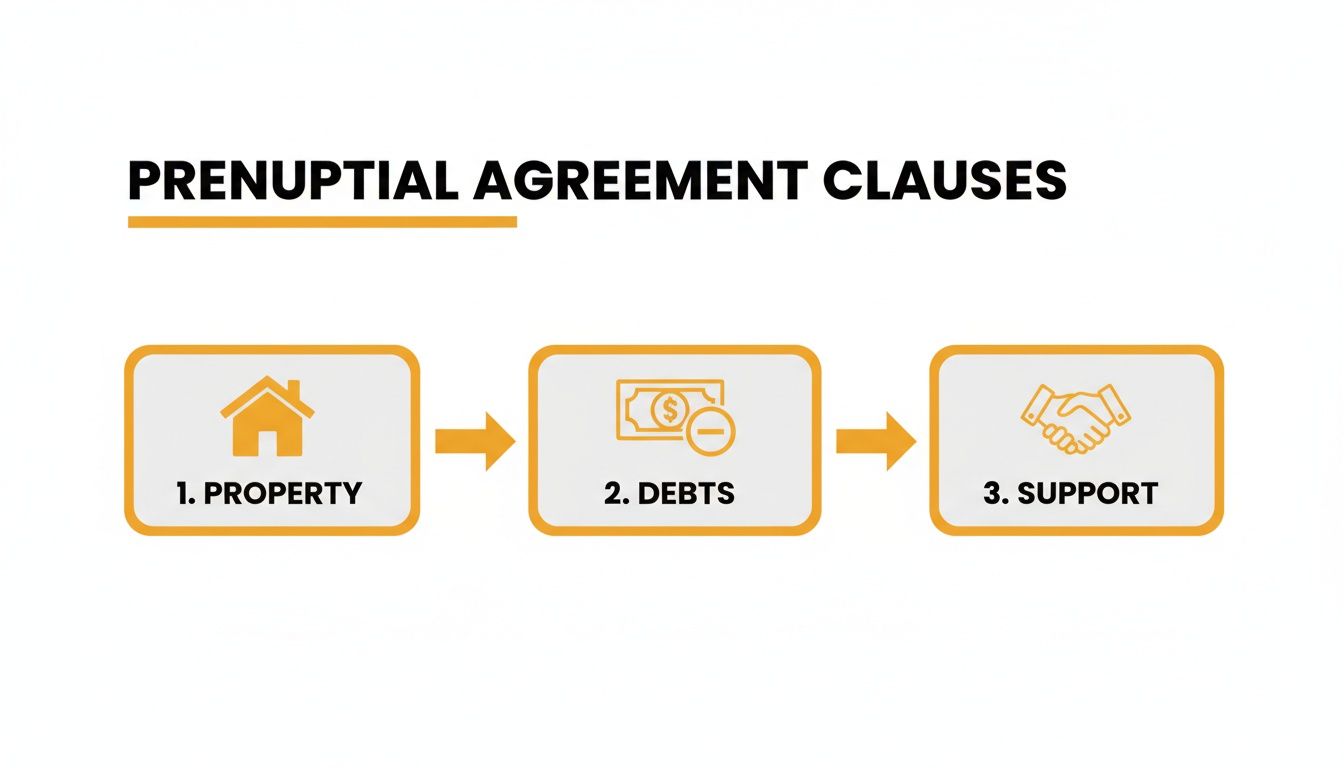 By thinking about your financial life in these three buckets—property, debts, and potential support—you can start to plan for the future systematically.
Step 3: Find the Right Lawyers
This part is legally critical: you and your partner must each hire your own lawyer. This is what’s known as Independent Legal Advice (ILA), and it’s there to ensure both of your interests are properly protected. It also prevents either of you from later claiming you felt pressured or didn’t fully understand what you were signing.
Look for family lawyers who have specific, hands-on experience drafting marriage contracts in your province. A good lawyer will guide you through the maze, explain the real-world implications of each clause, and advocate for your best interests while still fostering a collaborative tone.
Your lawyer’s job isn’t to stir up conflict. It’s to ensure fairness and clarity. Think of them as your expert guide, making sure the final document is legally sound and truly reflects what you both intended.
Step 4: Negotiate and Draft the Agreement
With your legal advisors on board, you’ll start negotiating the specific terms. This is where you get into the nitty-gritty, discussing everything from what happens to the matrimonial home to how spousal support might be handled. Your lawyer will then take these points and create the first draft of the marriage contract.
That draft is then shared with your partner’s lawyer, who will review it with them. It’s completely normal for there to be a few rounds of discussion and revisions. This back-and-forth is actually a healthy part of the process, ensuring the final contract is fair and something you’re both genuinely comfortable with. This kind of planning often intersects with other life decisions, which is why having an up-to-date will is just as important. To learn more, you might be interested in our guide on finding the right wills lawyer in Toronto.
Step 5: Finalize and Sign the Document
The last stop is the formal signing. Once everyone has agreed on the final version, you’ll each meet with your own lawyer to go over it one last time. They will confirm that you understand every term and agree to it completely.
You’ll then sign the agreement in front of a witness (usually your lawyer or someone in their office), and your lawyer will attach their Certificate of Independent Legal Advice. Once signed and witnessed by both parties, your prenup becomes a legally binding contract, giving you both a clear and secure foundation as you start your married life.
Common Mistakes That Can Invalidate Your Agreement
A prenuptial agreement, or marriage contract, is a fantastic tool for building financial clarity before you walk down the aisle. But here’s the tough truth: a poorly drafted agreement can be worse than having none at all. A few simple mistakes can make the entire document unenforceable, throwing you right back into the very disputes you were trying to prevent.
Think of it like building a protective wall around your future. If even one brick is weak or poorly placed, the whole structure can come crumbling down. Knowing the common pitfalls is the first step to making sure your agreement is solid, fair, and will actually stand up if you ever need it.
Rushing the Process
This is probably the biggest and most damaging mistake we see. Handing your partner a prenup a week before the wedding is a recipe for disaster. It immediately creates an atmosphere of pressure, and that haste can easily lead to a future claim of duress—an argument that one person was bullied or didn’t have enough time to properly think things through and get legal advice.
An Ontario court will absolutely look at the circumstances around the signing. If it looks like one person was cornered into a decision, a judge is very likely to set the agreement aside. The solution is simple: start the conversation months before the wedding. This gives you both plenty of time for calm negotiation and a thorough review.
A marriage contract should be the result of thoughtful, collaborative planning, not a last-minute scramble. Rushing completely undermines the fairness and consent that makes an agreement legally binding.
Incomplete or Dishonest Financial Disclosure
As we’ve mentioned, transparency isn’t just a nice-to-have; it’s a legal requirement. The absolute foundation of any valid prenuptial agreement in Canada is full and honest financial disclosure from both sides. You have to lay all your cards on the table—every asset, every debt, and every dollar of income.
Trying to hide a secret investment account or intentionally undervaluing your business is a critical error. If a court finds out that one person wasn’t truthful, it can toss out the entire contract. The logic is simple: the other person couldn’t have given informed consent because they didn’t have all the facts.
In Ontario, where UL Lawyers helps families navigate these issues, we rely on marriage contracts to protect assets. Family law experts can’t stress this enough: in provinces like Ontario, prenups must meet very strict financial disclosure rules to be enforceable. This is what prevents nasty future fights over spousal support or property division. Discover more about how these agreements work in Ontario and learn how UL Lawyers offers no-upfront-fee consultations to help clients draft ironclad agreements.
Using Vague or Ambiguous Language
In a legal document, clarity is king. Using fuzzy terms like “future business assets” or “reasonable support” without defining exactly what they mean is just asking for a fight later on. What seems obvious to you both today could be interpreted ten different ways a decade from now.
A properly drafted agreement is incredibly precise. It defines key terms and maps out specific scenarios. For example, instead of a vague mention of a business, a strong prenup will detail how its growth, any dividends, and a potential sale would be treated. This leaves no room for ambiguity—or expensive court battles.
Trying the DIY Approach
We get it, DIY legal kits seem like a great way to save money. But when it comes to marriage contracts, they are a huge risk. Family law in Ontario is a complex and nuanced field. A one-size-fits-all online template simply cannot account for your specific financial picture or guarantee it meets the latest provincial legal standards.
These generic documents almost always miss critical details, like the correct procedure for witnessing signatures or the mandatory inclusion of a Certificate of Independent Legal Advice. Investing in a family lawyer isn’t just an expense; it’s the single best insurance policy you can buy to make sure your agreement is strong, fair, and actually does the job you need it to do.
Answering Your Top Prenup Questions
Even after getting the basics down, you probably still have a few questions about prenuptial agreements. That’s completely normal. Let’s tackle some of the most common ones we hear from our clients all the time.
What Is the Difference Between a Prenup and a Cohabitation Agreement?
The real difference boils down to one simple thing: your marital status. A prenuptial agreement, which is technically called a marriage contract in Ontario, is for couples heading down the aisle.
A cohabitation agreement, on the other hand, is for common-law partners who live together but aren’t legally married. Both agreements do the same job—they lay out the financial ground rules for what happens to assets and debts if the relationship ends.
What’s neat about Ontario law is that it creates a smooth transition. If you have a cohabitation agreement and later decide to get married, it can automatically become your marriage contract.
How Much Does a Prenuptial Agreement Cost in Ontario?
There’s no single price tag for a prenup in Ontario. The cost really depends on how complicated your financial picture is. If you have straightforward assets and clear goals, the whole process—including the required Independent Legal Advice (ILA) for both of you—might cost a few thousand dollars.
But for couples with more complex finances, the price will naturally be higher. Think of situations involving:
- Business ownership or professional corporations
- Family trusts or significant inheritances
- Multiple properties or diverse investment portfolios
- Substantial debts that need careful planning
These scenarios take more time for lawyers to review financials, negotiate terms, and draft a rock-solid agreement. It’s best to see it not as a cost, but as a one-time investment in your peace of mind and financial future.
Think of a prenup as an insurance policy for your financial life. A relatively small investment now can protect you from devastating financial and emotional turmoil later by preventing a messy, drawn-out legal battle.
Can We Change or Cancel a Prenup After Marriage?
Absolutely. A marriage contract isn’t carved in stone. It’s a living document that can and should adapt as your life together changes. You and your spouse can decide to amend (change) or even rescind (cancel) the agreement after you’re married.
The key is that you have to follow the same legal steps as when you first created it. Any changes need to be put into a new written agreement, signed by both of you, and witnessed. It’s also highly recommended that you each get fresh Independent Legal Advice to make sure the new terms are fair, understood, and legally sound for your current situation.
Can a Prenup Protect My Personal Injury Settlement?
This is one of the most important things a marriage contract can do. Without a prenup, any personal injury settlement you get while married could be treated as family property. That means, upon a separation, it could be split with your spouse.
A carefully drafted prenup can specifically carve out those funds and define them as your separate, excluded property. This single clause ensures the money meant for your medical care, lost wages, and future well-being stays yours and yours alone. It’s a critical safeguard for your personal security.
For more answers to common legal questions, feel free to explore our comprehensive FAQ page.
Navigating the details of a prenuptial agreement can feel complex, but you don’t have to do it alone. At UL Lawyers, we specialize in creating clear, fair, and legally sound marriage contracts that protect your future. We are based in Burlington, Ontario, but serve clients across the entire GTA. If you’re ready to start a conversation, contact us for a free, no-obligation consultation today. Let us help you build a strong foundation for your life together. Learn more at https://ullaw.ca.